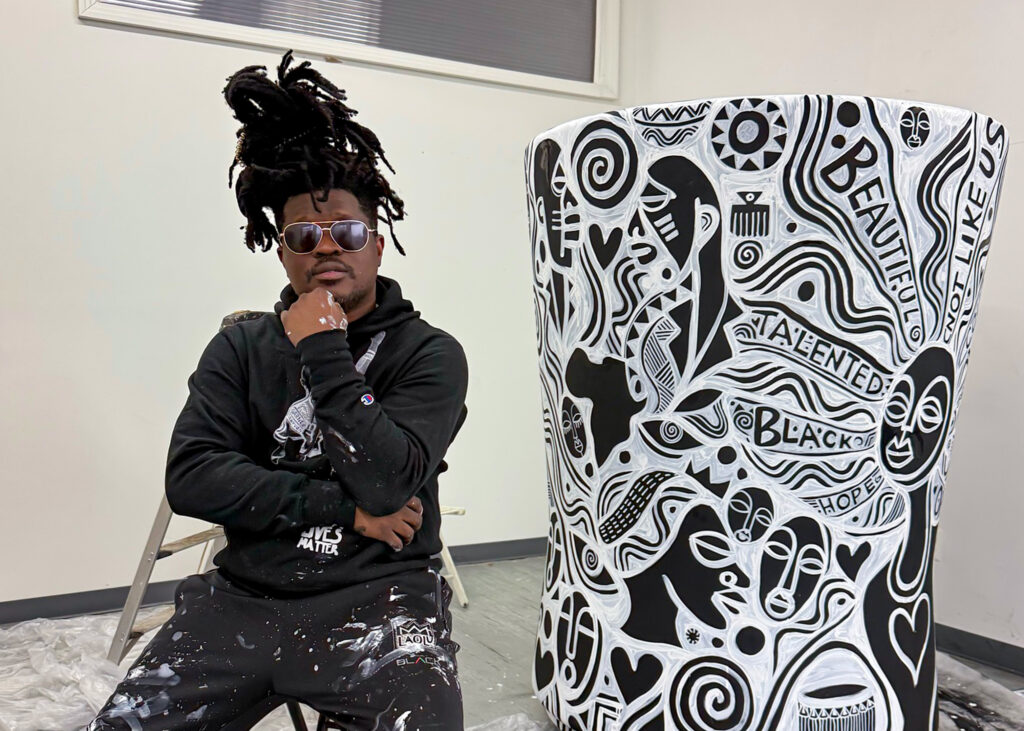
Laolu Senbanjo has taken Yoruba mythology from traditional symbols and patterns into global music, fashion, film and luxury, building a visual language he calls Afromysterics. In this conversation, the Nigerian artist reflects on the evolution of his work while making the case for African art to be studied and understood on its own intellectual terms.
Bonface Orucho, bird story agency
When Beyoncé released Lemonade in 2016, she turned an album into a visual world. In the film, Black women moved through Southern landscapes, water, ritual and memory, while bodies became canvases for intricate white markings that appeared almost like symbols from another world.
The artist behind most of those markings was Laolu Senbanjo, a Nigerian-born visual artist whose work had begun moving between the human body, canvas, fashion and objects.
His intervention in Lemonade would introduce his visual language to millions of people across the world, helping propel a practice rooted in Yoruba mythology into the centre of global pop culture.
Yoruba art has historically been extensively studied in the art world.
Its visual forms are intertwined with mythology, spirituality, philosophy and ideas about ancestry, destiny and the relationship between the physical and spiritual worlds.
The Metropolitan Museum of Art, for example, describes Yoruba ritual art as “part of interactions between humans and the orisa,” rather than simply objects created for aesthetic appreciation.
Senbanjo calls his own interpretation of this knowledge Afromysterics, “the mysteries of the African thought pattern”. He takes symbols, patterns and ideas drawn from Yoruba traditions and places them in contemporary settings, from painted bodies and canvases to luxury objects, music, fashion and film.
That approach has taken him from Nigeria to some of the world’s most recognisable creative platforms. He has worked with Beyoncé, Nike, Alicia Keys, Burna Boy and luxury brands, while his practice has expanded into film through projects including Children of Blood and Bone. Yet the ambition behind the work is larger than collaboration.
In this conversation, Senbanjo reflects on the evolution of his visual language, the Yoruba ideas that shape it.
This interview has been edited for length.
Could you start by introducing yourself; where you come from, what you do today, and maybe describe your practice in general?
My name is Laolu Senbanjo, visual artist and human rights attorney from Nigeria. Most of my work as an artist comes from Yoruba culture from the southwestern parts of Nigeria. I use symbols, patterns, ancient traditions and mythology to communicate through art in a contemporary way.
I draw from a very stylised form of art from the continent, including what you find in Oshogbo, on fabrics, carvings and different mediums. But I use it to interpret modern-day events.
I also use the term “everything is a canvas.” I could take that information and paint something as small as a shoe or suitcase, and I could also put that same information on a spaceship. I don’t believe artwork should just be limited to the walls of a museum or gallery. I believe art should be everywhere.
My mission is to bring a lot of the art from West Africa and the continent and put it on a global scale, so the world can also understand what we bring in terms of creativity.
**Take me a little bit back to Ilorin, where you were born. What was your childhood like? **
When I was about ten, I used to have a lot of visions. Just being able to see stories through looking at marbles on the floors or patterned walls. I would imagine stories, communities, people, action characters or movies in these abstract forms.
I would call my brother to come and see what I was seeing. Sometimes I realised that some of the things I saw, he didn’t see. That’s when I figured maybe I had a special way of seeing things because these things were very vivid to me.
I also started drawing comics. I was a very big fan of ‘Power Rangers,’ ‘Star Trek’, ‘Ninja Turtles’ and ‘Voltron’. I would draw my own versions. I was that type of kid.
Very early on, I wanted to be an artist, but eventually grew up to be an attorney.
Why law? How did you become a lawyer?
I’m Nigerian, born to Nigerian parents. My dad is an attorney. My brother is also an attorney, so it was almost a rite of passage.
Art was not something you told your dad you wanted to do. It was almost an unspoken code. You could be artsy, but that wasn’t what you did.
The professions on the list were law, medicine, engineering, accounting. Everything else was almost a disgrace to the family.
So I went through it, went to law school, got called and practised as a lawyer for a few years before saying, “Okay, cool. Now I’m going to focus on my art.”
At what point did you realise that art was not something you could keep on the side?
Probably when I started travelling.
My first exhibitions were in South Africa, Lagos and Germany. Throughout the movements, the planning and the visas, one thing I realised was that I could stand in these places and talk about art, even without a formal art education. I was able to hold my own and actually sell a few pieces that covered my trips.
That made me start thinking that this was something I could do for the rest of my life.
I wasn’t sure how it would happen or what medium I would use, but I never felt more alive doing anything than doing art. Running away from it felt more disillusioned than running towards it.
All my life I felt out of place in everything else until I started making art. It brought me back to my essence, my core, and the childlike person I always wanted to be.
You’ve created this term, Afromysterics. What does it actually mean?
Afromysterics was a term I coined in 2008. It means the mysteries of the African thought pattern, the thoughts, philosophies and different meanings.
When you look at the work of artists like Tola Wewe, Queen Nwaneri or Nike Okundaye, you see a lot of these thoughts. You see the wisdom of people who came way before me.
I tap into that wisdom. How would an African see a problem? How would he envision the world he wants to live in, and how would he create that world?
That is what Afromysterics is about.
When somebody sees one of your works today, what are they actually looking at?
They’re looking at a lot of work inspired by Yoruba mythology. You see symbols, wave patterns, faces, mask side profiles. Sometimes you see them juxtaposed with a suit, musical instruments or different objects.
When I am creating, I tap into those traditions and mythology. If I was doing something about human rights, for example, I might take elements from Yoruba mythological figures or stories.
Shango is the Orisha for justice, among other things. You might see scales borrowed from the idea of the justice scale. You might see a Yoruba axe. You might see a face or a mask.
A mask without pupils means an ancestor. One with pupils means an ancestor’s presence. When the mouth is closed, it means silence; when it is open, it means expression.
All these different things tell stories depending on what story you’re telling.
From that explanation alone, you’re speaking about symbols, patterns and lines. Can I say you’ve developed a visual vocabulary that you’ve developed over time that you use in most of your works?
Absolutely. I’ve developed a language based on things that came before me. I evolved it into something I’m doing today.
It makes it contemporary because I’m alive now and creating this body of work during the time I’m here. Hopefully, somebody else will pick it up from there.
Where does the spiritual dimension of the work come from?
A lot of it is Yoruba spirituality. The beautiful thing about Yoruba philosophy is that it’s all wrapped together.
It’s embedded in art, philosophy, physics, astrology and everything that has to do with your existence as a human being on the planet.
This is a unique perspective to look at the world through the lens of a Yoruba person. How would I want to portray my existence in the world?
I want the world to see me, but not just see me as a human. I want them to see the historical part of who I am, who came before me, what I’m willing to hear now and what I want people in the future to see when they look back at this period.
That’s what I think this is about.
You paint a lot on bodies. How different is it to paint on someone’s body compared to a canvas?
It’s almost like a 3D experience. You’re watching your work move. It’s almost a shared space.
With canvas, you have a lot of control because it’s almost an inanimate object. The human body is different. You have to work with proportions, muscles and anatomy. Everybody’s body is different, so each body’s art is different.
You have to look at what works with someone’s eyes, cheekbone, chin and neck. You work with the body, not to disfigure it, but to contain it in a way that creates something beautiful.
My philosophy is that if I placed this person in nature, next to a zebra, a tree or flowers, they should work together. There should be a seamlessness to it.
You almost can’t tell where life ends and where it starts.
At the end of the day, that artwork is washed away. How does that make you feel?
That’s the beautiful part.
The artwork starts with the first stroke. The entire thing is not when the art is done. It’s from the first line, the first figure, the first expression.
When the person looks at their own body or sees themselves in the mirror, there’s sometimes this revelation. They feel like they become somebody else. It’s almost like an inner person comes out.
Then pictures and videos become markers of the process. Those images are exhibited and also become references for paintings I create on canvas.
For the person I’m painting, it’s very spiritual. When they wash their body off, sometimes they say prayers. Sometimes I give prayers or explain what I’ve done.
It’s almost like a renewal. Like when you shed a skin. I give you a new skin, you enjoy it, and then you shed it and let it go.
It’s all part of humanity and existence itself, we’re here, we enjoy it, it’s beautiful, and we have to let it go.
Let’s talk about Beyoncé and project Lemonade. Before Lemonade, how established did you feel your own artistic language was?
Honestly, I felt confident in myself. I felt confident in my style and my artistry.
That’s why someone like Beyoncé would reach out and want to work with me. The work was already very set. It was vivid. It was bold. It spoke to a culture. It was clear.
I’m not ambiguous. I’m not hiding. I’m not trying to be what I’m not. When you see it, you know this is African or this comes from somewhere specific.
You might not understand it completely, which is okay. But it leaves you room to question and want to find out more.
Beyoncé reached out and said she wanted me to work on a music video. Then I got an email from Parkwood. Beyoncé said she loved my work, and they had actually gone through my YouTube, which had almost no subscribers. I thought, “How?” It meant somebody was actually looking.
I went to New Orleans to meet her and her team. They gave me more context about what I was doing and how it could add to Lemonade, which was a reflection of Black people and Black history.
It also connected back to Yoruba people and the continent. I was at that bridge of connection.
Meeting Beyoncé also answered a lot of questions I had been asking myself as an artist. It felt like, “Yeah, I’m on the right path. This is what I’m supposed to be doing.”
The project won Grammys and many other awards. That was confirmation: just keep doing it.
Do you feel or do you believe that project changed how people understood you as a person and your art?
Absolutely. That year changed my trajectory.
The project went viral reaching hundreds of millions of views. Within my own family, there had been years of doubt. “You’re never going to make it. You left law to do what? Paint on people?”
That moment changed everything.
Now I have nieces and nephews who want to be artists because they see an uncle who did something with it. I’m happy to be that inspiration.
I’ve travelled around the world since then. People email me from Japan, India and everywhere saying they love what I did in Lemonade. People are copying it and creating it in classes and schools.
I’ve been to Nairobi. I met Eliud Kipchoge and painted his arm for his foundation.
This artwork has brought me into spaces I never thought were possible.
Tell me more about Children of Blood and Bone. What’s the film about, and how did you become involved?
I met with the author three years ago, and she had informed me.
So the movie is an adaptation of a book. The author had informed me that part of the book was inspired by my work, which I was just so, it was an honour, honestly, because I felt like this is one of the biggest books.
I mean, I’ve seen this with Harry Potter when it comes to fantasy, because a lot of fantasy books, when it comes to African fantasy, it’s up there.
It’s a New York Times bestseller and it’s won so many awards. And also, it’s that book that has a cult following.
So when she said that, I had to grab the book and read for myself.
And oh my God, I was just mind-blown by the richness and the quality of the story that she was trying to tell.
Also, it’s a story that taps into a lot of African myth. It talks about magic. It’s all African. It’s all Black people, and there’s no white saviour complex anywhere in it.
It’s just the imagination of a beautiful world where it’s just us. I love that.
It’s a journey of people who eventually lost their magic and found their magic.
So pretty much, what I had to do is create, I come in as a cultural consultant on the movie, and I also had to create, like, work with a couple of the characters, and also had to create artwork in, like, a part of the set design, creating like a dome room, which also exists in a different scene in the movie.
You’ve since worked with Nike, Alicia Keys, Burna Boy and other major names. What do those collaborations allow you to do that a traditional gallery doesn’t?
They give room for something that exists more in the real world than in galleries.
Galleries can be a little gated and secluded. But when you collaborate with entertainers or people who move culture, the work stays with people. It goes into their homes, their psyche and the ether.
People live, breathe and work with it.
That’s important because art becomes personal. People can remember you without you having to run an advertisement.
I’m glad to be in that space because growing up, I didn’t see artists operating in that realm. Being that is something I’m grateful for.
It also matters for culture because these things are being documented. They live in people and in a generation, and people can reference them.
When you look back at your work so far, what do you hope people ultimately understand?
I hope people get to study it. I hope it gets into schools and eventually into the curriculum.
I hope people come to terms with the complexities of humanity, the beautiful things that unite us without looking first at the colour of someone’s skin or where they’re from.
For too long, people have looked at African art and called it “tribal” or “primitive.” That story has to die.
We’re coming into a new generation and a renewed understanding of what it means to be an African artist, whether Nigerian, Kenyan or Cameroonian.
Our complexity and the intellectual capacity of our minds should be respected like anyone else’s on the globe.
bird story agency
Useful links for editors:https://birdstoryagency.com/hollywood-2/,https://www.youtube.com/watch?v=edwh5fIwkMU&feature=youtu.be