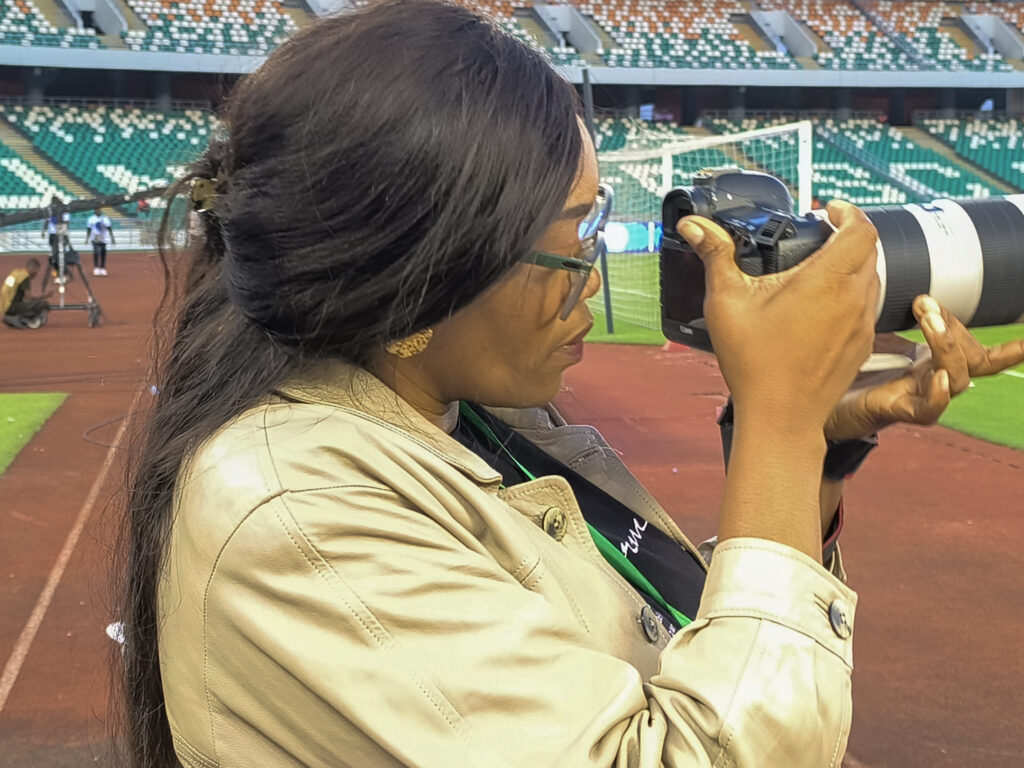
Béatrice-Nicole Kouadio began taking photographs as a young journalist because she needed images for her stories. What began as a practical tool then became a long-term career – one she has persevered with and succeeded in, despite the barriers of prejudice.
Mel Herve, bird story agency
The roar inside the stadium rises and collapses in waves. On the sidelines, photographers adjust their positions as the ball moves fast across the pitch, their shutters clicking in bursts to keep up with the speed of the game. In the stands, young men are singing, blowing whistles, and dancing, their energy levels rising and falling with every attack and counterattack, turning the match into a dynamic wall of sound and colour.
Among the photographers tracking the action from the edge of the pitch is Béatrice-Nicole Kouadio. Camera raised, body angled slightly forward, eyes moving before the play fully unfolds, Kouadio is comfortable, clearly used to this space. But there was a time when simply being here gave her a deep sense of unease, even rejection.
In 2009, in one of her early newsroom assignments, a senior male colleague made a remark she has never forgotten.
“They usually stop once they become wives or when they have children.”
Kouadio still remembers that sentence clearly. It was not said to discourage her directly. It was said as an explanation of how the field worked, who stayed, and who did not. But the words stayed with her very much longer than the assignment they were on that day.
At the time, she was not yet a photographer in the way she is known today. She was working in journalism, writing articles, and like many in the early 2000s in Côte d’Ivoire, she needed images to complete her stories. Around 2005, 2007, 2008, 2009, online media was growing, and photography became part of her routine rather than a defined career choice.
“I did not start photography because I believed in myself or because I had a passion for it,” she says. “It was because I needed images for my articles.”
She moved between assignments, learning on the job, carrying a camera without fully imagining that it would become the center of her professional life. In stadiums and press spaces, she quickly noticed what was consistent: she was often the only woman.
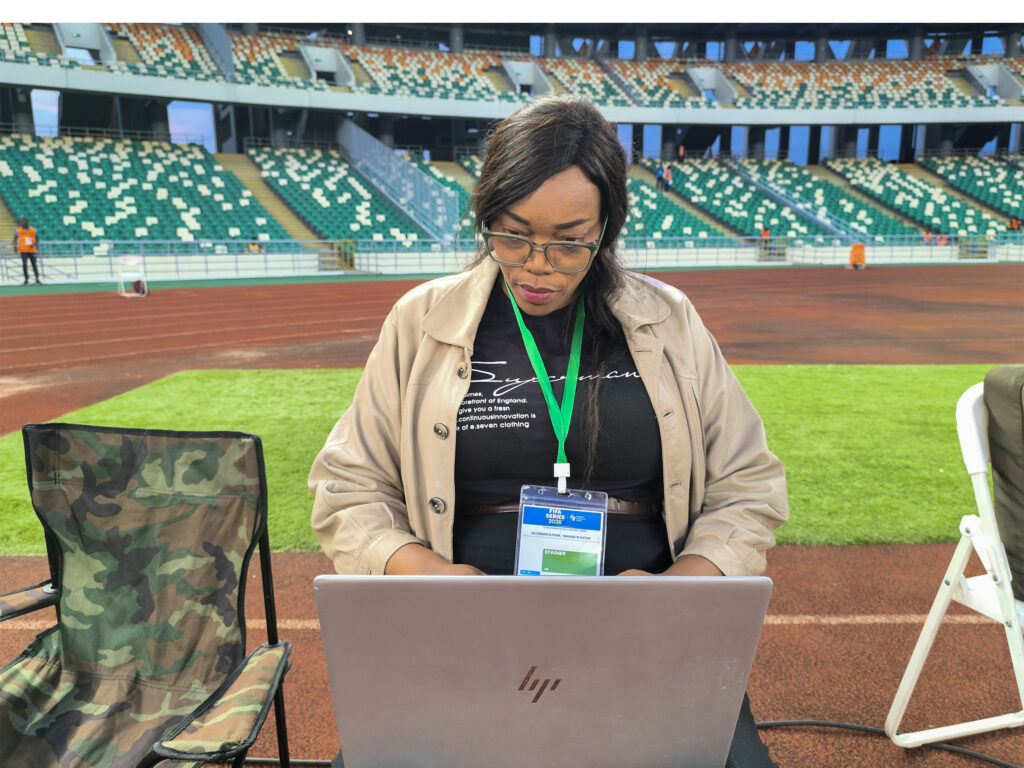
Béatrice Nicole, sports photographer and president of the Lumière sur L’Image association,working on her laptop at the Alassane Ouattara Olympic Stadium in Ebimpé, Côte d’Ivoire on April, 9, 2026. Photo: Mel Akoi, bird Story Agency.
“I was the only woman when covering matches or traveling,” she recalls. “There were senior colleagues who supported me, who showed me what to do and what not to do.”
At first, she did not question the absence of women around her. She worked, observed, and adapted. But over time, repetition sharpened into awareness. What had begun as a practical job was slowly becoming something larger—about visibility, continuity, and who gets to remain in the profession.
Nicknamed the Amazon of audiovisual, Kouadio has now spent more than fifteen years working as a sports and documentary photographer in Côte d’Ivoire, building a career in a field where women remain few.
Since 2011, she has built a career documenting international football. Her work spans major tournaments, including the Africa Cup of Nations with the Côte d’Ivoire national team and recent fixtures in the FIFA Series 2026. Positioned at the stadium sidelines, she records the technical play, spectator response, and the psychological intensity of the matches.
But beyond the images she captures, another part of her work has taken shape: mentorship.
One of the photographers she has trained, Arlette Mozou, describes the impact of that support as transformative.
“Already, her support has changed the way I see photography, it has changed the way I work on my photos, even how I take them. Before, my photos were blurry, not sharp. Now, I am able to properly adjust my camera and take good photos. You can visit my pages and you will see the evolution of my photos from before to today.”
For Béatrice-Nicole, this transfer of knowledge is not incidental—it is intentional. At training sessions such as those held at the Orange Digital Center during the fifth edition of Abidjan Cine Scratch, she speaks directly about what it means to pass on skills in a field where informal learning has long been the norm.
“Training the youth means passing on knowledge, building a legacy. And if today young people are becoming more interested in our field, it gives them the possibility to sustain our profession, to ensure that we are not forgotten. Because if we do not pass on knowledge, young people will not be impacted, they will not have the information about what we do, and they will not know whether it is a profession or a field that can have great impact, that is to say great value.”
Her work is also shaped by a broader conviction: that African stories should be told by those who live them.
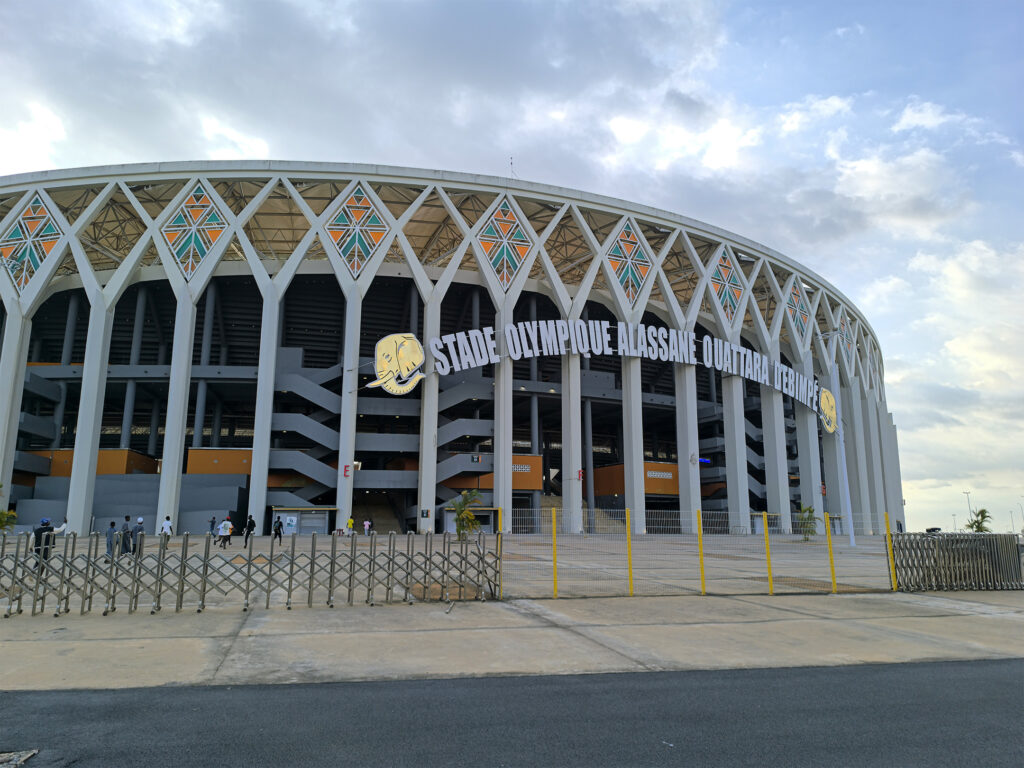
The façade of the Alassane Ouattara Olympic Stadium, an architectural masterpiece with imposing columns, during the first day of the FIFA Women’s Series tournament, in Ebimpé, Côte d’Ivoire on April, 9, 2026. Photo: Mel Akoi, bird Story Agency.
Speaking during an immersion at the Alassane Ouattara Olympic Stadium in Ebimpé, during the FIFA Series 2026 and a match where Côte d’Ivoire’s women’s team recorded a strong win over Mauritania, she frames photography as both practice and responsibility.
“We have the chance to practice a profession that is a storytelling tool, a storytelling tool that allows us, as Africans, to tell the human story of sport and African football,” she said. “It is important that we do it ourselves. Because it is our history, our heritage, our legacy, our culture, it is our footprint.”
Her perspective reflects a gradual but visible shift in sports media spaces in Côte d’Ivoire, where more women are entering press zones, stadiums, and editorial workflows.
While still a minority, women photographers are increasingly present in major sporting arenas globally, reflecting a gradual but steady shift in who documents sport at the highest level. Recent data from the International Olympic Committee shows that women made up about 18% of accredited sports photographers at the 2026 Winter Olympics, up from 15% at the 2024 Paris Games and 13% at the 2022 Beijing Games, marking a consistent upward trend over successive Olympic cycles.
Veteran photographer Seibou Traoré, who has worked in West Africa for over two decades and once served as official photographer to the President of Côte d’Ivoire, observes this shift closely.
“Women have a touch they can bring to photography, their touch of femininity, and that is important,” he said. “When women enter fields traditionally reserved for men, they should not become men, but remain women who do their work in these fields. This feminine touch will sharpen their perspective.”
Alongside her technical work, Béatrice-Nicole is also focused on something more structural: access. For her, inclusion in photography is not only about presence, but about economic independence and opportunity.
“For me, it is truly a real mission,” she said. “If we manage to impact one more woman, we take a woman out of unemployment, we make her independent, and we give her the opportunity to discover our field, which can be a profession of the future for her and can also give her the chance to secure a job so that she can be financially independent.”
Her lens is not limited to sport. She moves between cultural events, ceremonies, and everyday social life, documenting moments that might otherwise pass unnoticed. Across these assignments, she focuses on emotion and spontaneity—the unposed reality of how people live through the events around them.
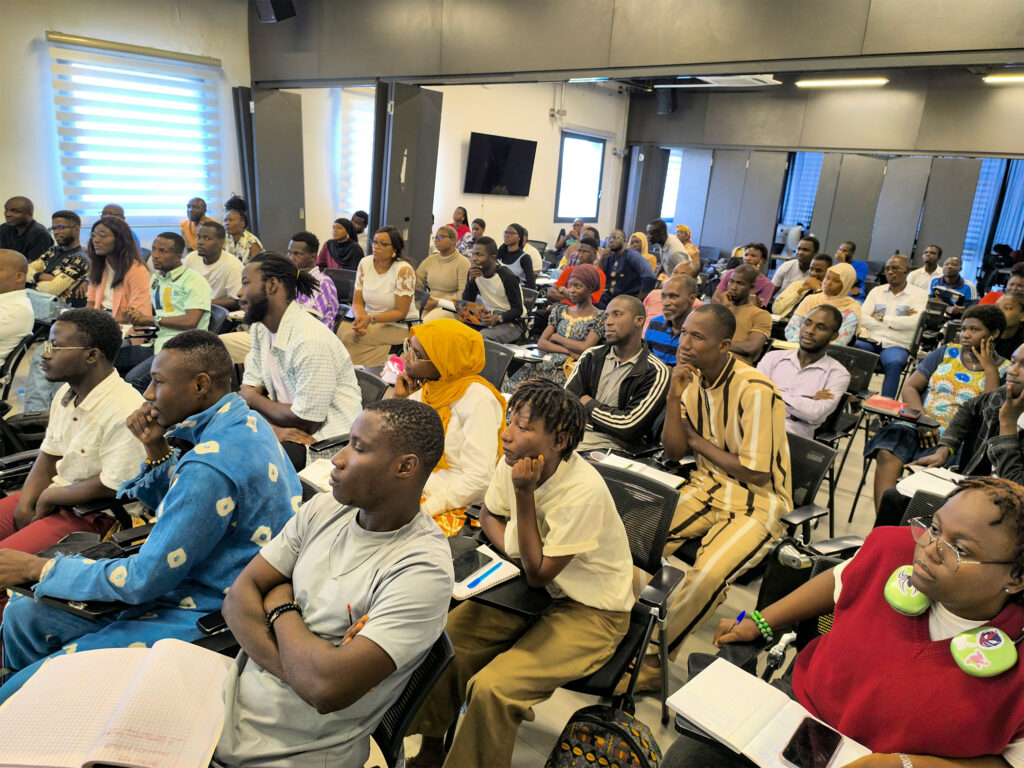
Participants listening keenly during a photography workshop led by Béatrice Nicole at the Orange Digital Center, Côte d’Ivoire on April, 13, 2026. Photo: Mel Akoi, bird Story Agency.
Back in Abidjan’s stadiums, where football continues to draw large crowds and intense emotion, she remains one of the photographers tracking every decisive movement from the sidelines. Around her, a new generation is beginning to take up space in the same press zones she once entered alone.
The field is still demanding. The numbers are still uneven. But the presence is no longer isolated.
And for Béatrice-Nicole Kouadio, that difference is part of the story now.