M-KOPA’s expansion in Ghana highlights how device financing is evolving into bundled ecosystems that combine payments, protection, and financial products into a single repayment structure.
Bonface Orucho, bird story agency
Across Africa’s low-income markets, the smartphone is increasingly acting as the first point of contact with formal financial systems, replacing traditional banking entry points.
M-KOPA’s expansion in Ghana illustrates how device financing is evolving into a bundled ecosystem that integrates credit, insurance, and digital services into a single daily payment structure.
M-KOPA’s latest Ghana Impact Report, published on May 20, 2026, shows the company has unlocked more than GHS 1.2 billion (more than US$103 million) in credit for over 550,000 customers since 2021.
The report frames this not as device sales but as financial inclusion delivered through a smartphone-led platform that combines financing with embedded services such as health insurance and connectivity.
The shift is emerging against a persistent structural constraint in African digital economies: affordability.
While mobile money and digital services are expanding across Africa, access to smartphones remains deeply unequal. A 2025 GSMA study found that an entry-level smartphone can cost the poorest 20% of people in Africa up to 87% of their monthly income.
This affordability gap has created a parallel market structure where access to credit, insurance, and digital platforms is often mediated by informal systems or fragmented service providers.
Device financing models are now attempting to consolidate these access points into a single product.
M-KOPA’s Ghana model is anchored on its “More than a Phone” platform, launched in January 2025.
Instead of financing smartphones alone, the company bundles devices with data plans, insurance, and device protection, all paid through daily installments.
The company reports that sales in Ghana grew fourfold following the rollout of the model across all 16 regions through a network of more than 3,000 agents.
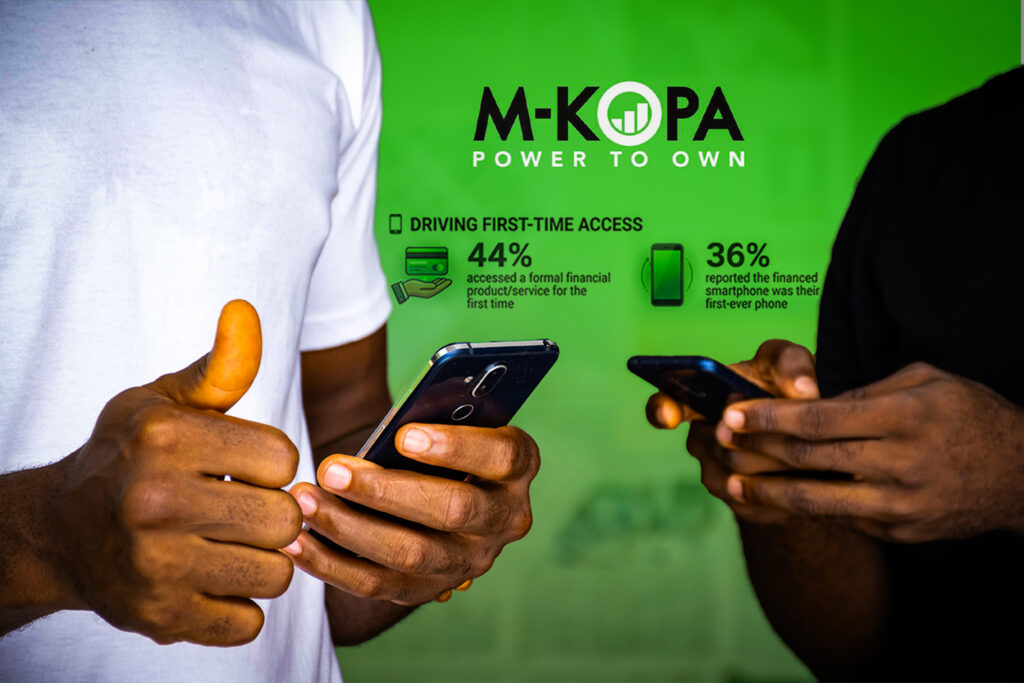
According to the Ghana Impact Report, 44% of customers accessed a formal financial product or service for the first time through M-KOPA, while 36% said the financed smartphone was their first ever phone.
The insurance layer reinforces this shift. Through its partnership with insurtech firm Turaco, M-KOPA reports that 67% of insured customers accessed health insurance for the first time.
The company also notes that 43% of women said they chose the device specifically because it included health cover.
The expansion of embedded financial products reflects a broader structural transition in African fintech distribution.
Industry analysts describe embedded finance as the integration of financial services into non-financial products, allowing credit, insurance, and payments to be delivered at the point of use rather than through traditional institutions.
Speaking at the 2026 3i Africa Summit in Accra, Johnson Pandit Asiama, the governor of the Bank of Ghana, said Africa was moving beyond basic payments infrastructure toward a new phase centered on “digital credit, embedded finance, merchant payments, supply chain finance, and cross-border services.”
“Africa has reached a point where participation is no longer the ambition; leadership is,” he said.
Asiama argued that the continent’s next challenge was no longer access alone, but how effectively African markets coordinated infrastructure, regulation, and capital to scale digital financial systems sustainably.
In Africa, embedded finance is increasingly being implemented through telecom platforms, fintech ecosystems, and device financing structures, where financial services are integrated directly into consumer acquisition pathways.
M-KOPA’s model reflects this shift, where the device becomes the delivery mechanism for multiple financial products rather than a standalone asset.
In Kenya, M-KOPA and Turaco have already scaled embedded health insurance to more than 1 million customers in a single year.
Coverage is integrated directly into smartphone repayment plans, with customers receiving hospital cash compensation during periods of admission.
Turaco reports that it now provides insurance coverage to more than 5 million people across Africa, with around 75% accessing insurance for the first time.
Premiums are structured at low entry points, in some cases as little as US$0.50, reflecting the unbundling of traditional insurance products into micro-payments.
Mobile money platforms are also reinforcing this distribution model. Systems such as M-Pesa have expanded beyond payments into credit, savings and insurance distribution across multiple African markets, effectively creating a financial operating layer on top of mobile connectivity infrastructure.
The result is a convergence between telecom infrastructure, fintech systems and consumer devices, where multiple layers of the formal economy are increasingly accessed through mobile interfaces rather than traditional banking systems.
Regulators however, say Africa’s financial inclusion transition is not being driven by smartphones alone, but by financial systems designed around technologies already embedded in daily life.
At the same summit, Matilda Asante Asiedu, the second deputy governor of the Bank of Ghana, said Ghana’s financial inclusion rate had reached 81%, driven largely through mobile money agents and basic phone-based transactions.
“Anyone and everyone can send money from a phone with no internet connection, no smartphone, no app, no data plan, just a basic phone and a USSD code,” she said.
Asiedu argued that Africa’s digital finance expansion would depend on infrastructure tailored to local conditions rather than imported high-end digital models.
“Trust is at the heart of any financial transaction,” she said, adding that interoperable payment systems, consumer protection and regulatory coordination would determine how effectively African digital finance scales across borders.
Across M-KOPA’s customer base, the company reports that more than half of users now use their devices for income-generating activities.
Around 54% say they earn more money after acquiring the smartphone, while 76% report improvements in quality of life.
The financing structure is central to this outcome. By converting upfront device costs into daily payments, M-KOPA links access to cash flow rather than accumulated savings.
This allows low-income households to enter digital economies without the barrier of lump-sum capital requirements.
Similar embedded models are visible in other African markets.
In Kenya and Uganda, 4G Capital provides working capital loans to informal businesses using mobile money repayment systems and algorithmic credit scoring.
The company combines financing with business training, creating a bundled approach to MSME support that mirrors the logic of device-linked financial inclusion.
Telecom operators are also moving deeper into financial ecosystems. Africell has expanded its services beyond connectivity into micro-finance, payments and insurance distribution, reflecting a broader industry trend where telecom infrastructure is becoming a primary channel for financial services delivery.
Behind these models is a growing infrastructure layer of fintech companies enabling embedded financial services.
Platforms such as Stitch in South Africa provide payment APIs and financial infrastructure that allow businesses to integrate banking services directly into their platforms.
This reduces reliance on traditional banking rails and supports real-time financial transactions embedded within non-financial products.
JUMO, operating across multiple African markets, has built mobile-native credit systems that use behavioural and transactional data to underwrite loans.
The company partners with banks and telecom operators to distribute credit at scale through mobile-first interfaces.
“To attract more investment into Africa’s digital economy, we must build the architecture that allows innovation to grow,” Asiedu said at the 3i Africa Summit, pointing to interoperable payment systems, trusted digital infrastructure and regulatory coordination as the next phase required to scale Africa’s embedded finance economy.
bird story agency
Useful links for editors:https://www.m-kopa.com/newsroom/m-kopa-ghana-impact-report-reveals-smartphones-are-unlocking-health-insurance-and-economic-opportunity-for-every-day-earners#:~:text=Since%20launching%20in%202021%2C%20M,of%203000%2B%20direct%20sales%20agents.&text=Key%20Stats%3A,first%20time%20through%20M%2DKOPA,https://citizen.digital/article/financial-times-ranks-turaco-among-africas-fastest-growing-companies-n382627