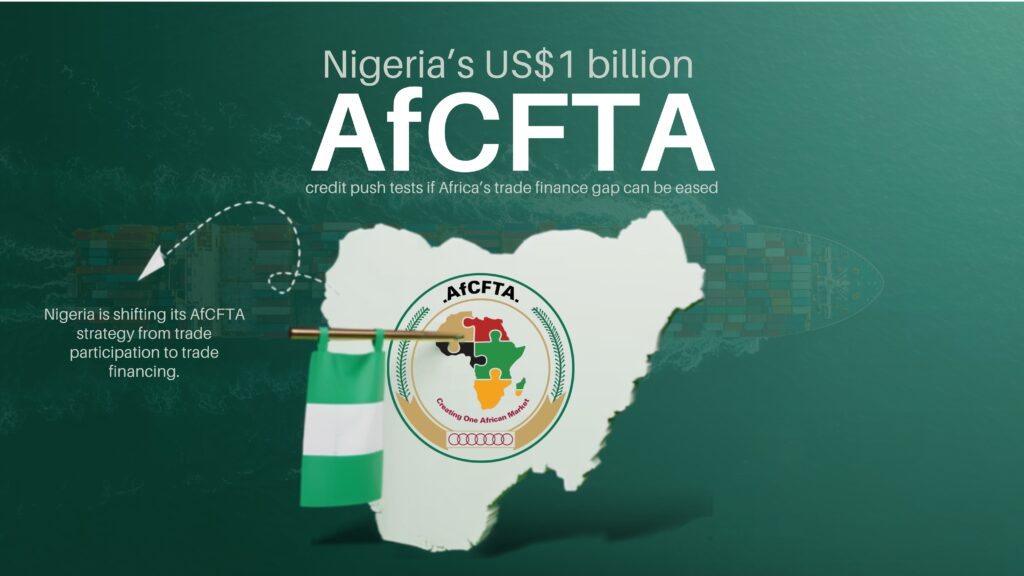
Nigeria’s US$1 billion AfCFTA credit facility is a trade financing strategy that is positioning access to capital as a central lever for unlocking regional markets. The initiative serves as a test case for whether it is possible to address a broader continental constraint of limited trade finance that continues to slow the operational impact of Africa’s free trade agenda.
Bonface Orucho, bird story agency
Nigeria is shifting its AfCFTA strategy from trade participation to trade financing, unveiling a US$1 billion credit facility aimed at expanding the capacity of firms to produce and export across African markets.
The move reflects a broader attempt to address a constraint repeatedly identified by development finance institutions: access to capital remains central to whether African firms can actually trade under the continental free trade framework.
“The AfCFTA remains one of the most significant economic integration projects in our continent’s history,” Nigeria’s minister of industry, trade, and investment, Jumoke Oduwole, said during a meeting of the AfCFTA Central Coordination Committee.
Her comments align with a wider policy concern across the continent that tariff liberalization alone is insufficient to generate trade flows without corresponding improvements in productive capacity and financing.
According to Afreximbank, Africa faces an annual trade finance gap exceeding US$100 billion, limiting firms’ ability to access working capital and investment finance required for cross-border trade.
According to the African Development Bank, small and medium-sized enterprises dominate the business landscape but continue to face the most severe constraints in accessing credit for expansion and export readiness. The World Bank similarly identifies access to finance as one of the most binding constraints on private sector growth in Africa.
Taken together, these assessments point to a structural bottleneck in AfCFTA implementation, where policy frameworks have advanced faster than the financial systems needed to operationalize them.
The US$1 billion facility is part of the AfCFTA Adjustment Fund architecture, established by the AfCFTA Secretariat and Afreximbank in 2022 to support implementation of the continental trade agreement.
According to Afreximbank, the Adjustment Fund is structured around three components. The Base Fund supports tariff-related adjustments and implementation costs. The General Fund provides concessional financing. The credit fund mobilizes commercial financing for both public and private sector actors seeking to participate in AfCFTA-linked opportunities.
Afreximbank estimates that the broader Adjustment Fund requires between US$8 billion and US$10 billion over a 5 to 10-year period to support implementation across member states.
Nigeria’s facility sits within the Credit Fund component, which is designed to mobilize commercial capital for productive sectors linked to regional trade.
Patience Okala, National Coordinator of the Nigeria AfCFTA Coordination Office, said the facility targets large corporations seeking to expand production, strengthen competitiveness, and scale exports across African markets.
“Under the Adjustment Fund, there is a credit fund scheme of US$1 billion for large corporates,” she said.
She added that eligible firms must demonstrate capacity to absorb at least US$10 million, meet governance and financial criteria, and show alignment with AfCFTA objectives, including regional value chain integration, industrialization, and import substitution.
“The facility can be provided as a term loan, working capital, trade finance facility, or project finance to support expansion, modernization, and market-entry initiatives under AfCFTA,” she said.
Officials say access will be mediated through the Nigeria AfCFTA Coordination Office and designated fund managers, with a pipeline model used to identify qualifying firms rather than open retail applications. Pilot companies have already been identified, including women-led enterprises, although no public disbursements have been confirmed.
Legal and trade experts say the initiative could improve the readiness of Nigerian firms to participate in continental markets, provided firms are able to meet the technical and financial thresholds required.
According to Eunice Iretioluwa Banjo, a trade and corporate governance specialist, the facility signals a more practical phase of AfCFTA implementation focused on enabling businesses to compete across African markets.
“The fund will increase production capacity, improve competitiveness, and accelerate intra-African trade under the African Continental Free Trade Area (AfCFTA),” she said.
She added that the success of the initiative will depend on whether firms can translate access to finance into export capacity, compliance readiness, and sustained competitiveness in regional markets.
Nigeria’s implementation record provides context for the financing push.
According to the Nigeria AfCFTA Coordination Office, the country recorded its first shipment under AfCFTA preferential trading terms in January 2025, when synthetic filaments produced by Lucky Fibres Limited arrived at the Port of Mombasa in Kenya. The shipment marked Nigeria’s entry into preferential continental trade under the agreement.
Since then, Nigeria has expanded implementation efforts to include export facilitation tools, air cargo corridor development, and coordination between customs, export promotion agencies, and trade regulators.
In March 2026, the federal government also launched a report on cross-border digital payments and identity systems under AfCFTA. According to the government, the initiative is designed to reduce transaction costs and improve access to continental markets through systems such as the Pan-African Payment and Settlement System.
Despite widespread ratification of AfCFTA, implementation across the continent remains uneven.
So far, only a limited number of African countries have been publicly confirmed as participating in structured goods trade under the AfCFTA’s Guided Trade Initiative, the Secretariat’s mechanism for testing preferential trade flows. Transactions under this framework began in late 2022 to test customs readiness, rules of origin procedures and tariff application under real trading conditions.
According to AfCFTA implementation updates and Secretariat communications, the initial pilot group included Ghana, Kenya, Rwanda, Tanzania, Mauritius, Egypt, Cameroon and Tunisia. These countries were selected based on the approval and publication of their tariff schedules and readiness to test AfCFTA trading documentation and customs procedures.
The goods tested under the initiative have broadly included manufactured and processed products such as coffee, tea, ceramic tiles, processed foods, sugar-based products, textiles and light industrial inputs, reflecting early attempts to validate regional supply chains under the agreement.
Subsequent participation has expanded as additional countries complete domestic legal incorporation of tariff schedules and rules of origin frameworks. South Africa and Nigeria have been reported among countries engaging in AfCFTA preferential trade flows as implementation deepens, particularly in industrial and value-added product categories.
Notably, before Nigeria’s facility announcement, the AfCFTA Adjustment Fund Credit Fund had already begun operationalization through its first disclosed investment. According to Afreximbank, the Credit Fund closed its inaugural transaction in July 2025, committing US$10 million to Telecel Global Services Ltd. through a senior secured amortizing loan.
The facility is supporting the company’s expansion and digital infrastructure development in Ghana and Liberia.
bird story agency
Useful links for editors:https://afreximbank.africa-newsroom.com/press/african-continental-free-trade-area-afcfta-adjustment-fund-credit-fund-closes-its-first-deal–us-10-million-investment-in-telecel-global-services-ltd?lang=en,https://media.afreximbank.com/afrexim/African-Trade-Report_2025.pdf