Easier trade, reliable power and predictable policies could help African businesses turn the continent’s young workforce and vast resources into jobs and rising incomes. Finance and business leaders say delivery will determine how far—and how fast—that transformation goes.
By Des Latham, bird story agency
Buying goods from China should not be easier for an African business than buying from a neighbouring country. Yet that remains the reality for many firms—a barrier that Nigeria’s Taiwo Oyedele argues Africa must dismantle to give its industries room to grow.
His challenge cuts to the heart of the continent’s growth ambitions: how to turn young populations, expanding cities and abundant resources into competitive businesses, productive jobs and higher living standards.
At an IMF–World Bank panel on Africa’s economic future, finance and business leaders identified three connected priorities: reforms that give investors confidence, regional integration that helps companies reach bigger markets, and electricity and transport networks that make production and trade possible. The opportunity is substantial, they argued, but its value will depend on implementation.
Across the global economic landscape, a profound demographic and structural realignment is quietly taking shape. As industrialized nations contend with aging workforces, shrinking labor pools, and sluggish productivity gains, the African continent stands as the world’s premier emerging growth engine. Armed with the world’s youngest and fastest-growing population, vast deposits of critical minerals essential for the green transition, and rapidly expanding urban centers, Africa holds an unprecedented opportunity to redefine global trade and industrial production.
Yet, translating this vast potential into sustained increases in living standards, dynamic job creation, and broad-based prosperity requires more than intent—it demands decisive structural reforms, frictionless regional integration, and an environment engineered to attract long-term private capital.
Speaking at this week’s IMF/World Bank Annual Meeting, a panel of five public and private sector leaders was convened under the title “Africa’s Golden Future: Structural Reforms, Trade Integration, and Private Sector-Led Growth.”
The international policymakers, finance ministers, development leaders, and private sector executives gathered to chart a clear path forward. The overriding takeaway was unmistakably clear: while headwinds remain, the momentum behind Africa’s economic transformation is accelerating. Through ambitious domestic policy overhauls, the transformative promise of the African Continental Free Trade Area (AfCFTA), and innovative capital mobilization, the foundation for Africa’s golden future is being actively laid.
Domestic Structural Reform
For decades, many African economies relied heavily on commodity price cycles or public-sector borrowing to fuel expansion. However, with elevated global interest rates, tightening international aid budgets, and constrained fiscal spaces, the trajectory has shifted. Sustainable, high-velocity growth must now be underwritten primarily by private enterprise.
Opening the discussion, Bo Li, Deputy Managing Director of the International Monetary Fund (IMF), framed the economic imperative with stark clarity.
“At Africa Forward Summit in Nairobi, our managing director highlighted that Africa is where the world will acquire its next growth engine. The case for optimism is strong,” Li noted, stressing the continent’s unprecedented demography.
“Consider the arithmetic: At Sub-Saharan Africa’s recent growth pace, income per person would take roughly half a century to double, more than three times what it took East Asia during its takeoff… Closing half the gap with emerging markets in governance, business regulation, and market openness could raise Sub-Saharan Africa’s output by as much as 20% over five to 10 years.”
The empirical foundation supporting this optimism is robust. According to IMF regional economic outlooks, Sub-Saharan Africa is home to some of the world’s fastest-growing economies, with regional growth projected to rebound strongly toward 4.5% in the coming years. Furthermore, with over 60% of its population under the age of 25, Africa will contribute over half of the global population growth through 2050—providing an unmatched demographic dividend at a time when global labor supply is contracting elsewhere.
Across the continent, major economies are taking bold, politically challenging steps to address structural distortions and build credible macroeconomic foundations.
In Nigeria—one of the continent’s largest economy—the government has embarked on comprehensive fiscal and monetary realignments aimed at removing deep-seated market inefficiencies. Nigerian Minister of Finance and Coordinating Minister of the Economy, Taiwo Oyedele, detailed the strategic sequencing required to navigate high-stakes reforms, such as fuel subsidy removal, foreign exchange unification, and tax overhauls.
“The starting point is always to bear in mind before you start your reforms, you should have the end in mind,” Oyedele explained. “Overall, we think that these reforms have really set the foundation for us upon which we are building now the ambitious growth, inclusive job reach that we want for our people in the coming months and years ahead.”
Similarly, North African powerhouses are institutionalizing reforms to enhance resilience against external global shocks. Ahmed Rostom, Egypt’s Minister of Planning and Economic Development, highlighted how Egypt navigated multiple global crises by committing to institutional governance, flexible exchange rate regimes, and explicit state ownership policies that safeguard private enterprise.
“We stick to a reform agenda that has been ongoing… We believe in the significance and the importance of having a flexible exchange rate management that is really acting as a key shock absorbent,” Rostom stated. “In addition to this, the belief in a stronger private sector led model, unlocking the opportunities for leveling the playing field… ensure that we weather the implications of successive shocks.”
The AfCFTA Imperative and unlocking a $3.4 Trillion Single Market
While domestic policy stabilization is essential, individual African markets have historically suffered from fragmentation. The implementation of the African Continental Free Trade Area (AfCFTA) represents a watershed moment, creating a single, borderless market encompassing 1.3 billion people with a combined Gross Domestic Product (GDP) exceeding $3.4 trillion.
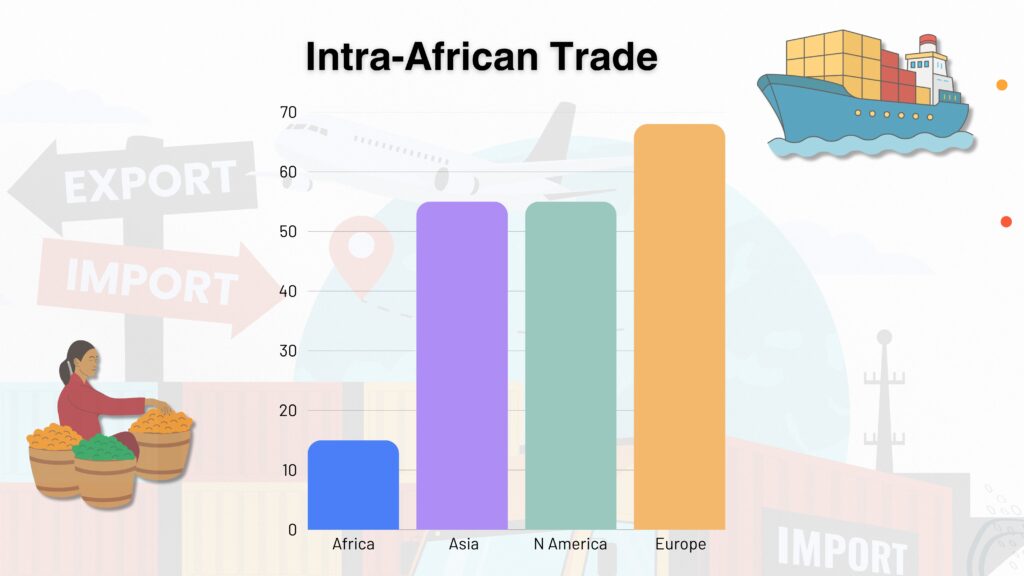
Currently, intra-African trade accounts for approximately 15% to 18% of the continent’s total commerce—a figure strikingly low compared to Europe (roughly 68%) or Asia (59%). The World Bank estimates that full implementation of the AfCFTA could lift 30 million people out of extreme poverty, boost regional income by 7% (or nearly $450 billion), and significantly expand manufacturing export output.
To turn this vision into commercial reality, countries are prioritizing the removal of non-tariff barriers, digital customs harmonization, and major transport infrastructure projects.
Minister Oyedele emphasized that removing internal barriers is key to scaling African industries to compete internationally:
“It should not be easier for someone in Lagos, Rwanda, Nairobi, Johannesburg to buy from China than it is to buy from Africa. Unfortunately, that’s the current reality,” Oyedele candidly observed.
“What AfCFTA is trying to do is to turn 54 countries into one market, so that way it’s easy for us to scale. But that will not happen until we remove the barriers, and many of them are actually non-tariffs.”
To accelerate borderless trade, Nigeria is deploying advanced trade technology, including a National Single Window system, alongside transformative physical infrastructure investments such as coastal superhighways and modernized port facilities.
North Africa is similarly leveraging its unique geographic and industrial capacity to act as a continental gateway. Highlighting the pivotal role of global trade arterial routes like the Suez Canal—which handles roughly 12% of global trade and a third of global container traffic—Minister Rostom underscored Egypt’s strategy to link African producers directly to Mediterranean and Middle Eastern supply chains.
“North Africa has a distinct role to play with its ports, industrial bases, and abundant renewable energy potential,”Rostom noted, calling for deeper integration.
“We have to do more when it comes to harmonization of rules, mutual recognition of rules of origin, and leveraging technology… We also believe investment in green energy transition is critical to facilitate trade, embarking on an ambitious plan to rely 45% on renewable sources by 2030.”
Infrastructure, Power, and the Capital Bridge
A key consensus among speakers was that policy frameworks alone cannot drive economic expansion without physical enabling infrastructure—most notably reliable energy and transport networks. Today, nearly 600 million people across Africa lack access to electricity, representing both a major development challenge and one of the largest infrastructure investment opportunities globally.
To tackle this gap, regional development banks and multilateral institutions are stepping up with ambitious execution frameworks. Sidi Ould Tah, President of the African Development Bank (AfDB) Group, detailed how development institutions are moving from policy announcements to concrete, ground-level delivery.
“I think we all agree on the diagnosis… but what is important is how to move from decree to delivery, and how to make reform reality,” Tah declared. He highlighted Mission 300 (M300)—an initiative launched alongside the World Bank and global partners aimed at connecting 300 million Africans to electricity by 2030.
“More than 30 countries have joined… providing support not only to the implementation of reform, but to the physical infrastructure, private sector entry, and ensuring competition.”
For private investors, clear execution, regulatory consistency, and predictable policy environments are the primary catalysts that convert potential into long-term equity deployment.
Daniel Mminele, Chairman of Nedbank Group Limited, provided the investor perspective on what turns risk perceptions into sustainable capital flows.
“Macroeconomic stability is the starting point. That’s the ticket to the game. Without it, there’s no point in talking about long-term investment,” Mminele explained.
“What investors look for in structural reforms is discipline in priorities, implementation capacity, and institutionalization… The difference between great potential and a lived reality is implementation. Once you have policy certainty, the risk premium comes down, and capital—both in amount and price—starts flowing.”
A Bright Horizon Built on Action
Africa’s economic narrative is undergoing a decisive shift. The continent is actively building the institutional, technological, and physical architecture required to power its own future. By pairing macroeconomic stabilization with deep regional market integration under the AfCFTA, and backing these efforts with targeted energy and transport infrastructure, African nations are dismantling long-standing barriers to growth.
As global savings seek out dynamic, high-yielding growth destinations, Africa’s expanding consumer markets, digital transformation, and young workforce present an undeniable value proposition. The journey is complex and requires sustained political willpower, but as momentum builds from Cairo to Lagos and Johannesburg, the vision of an interconnected, prosperous, and self-sustaining continent is no longer a distant aspiration—it is actively taking shape.
bird story agency