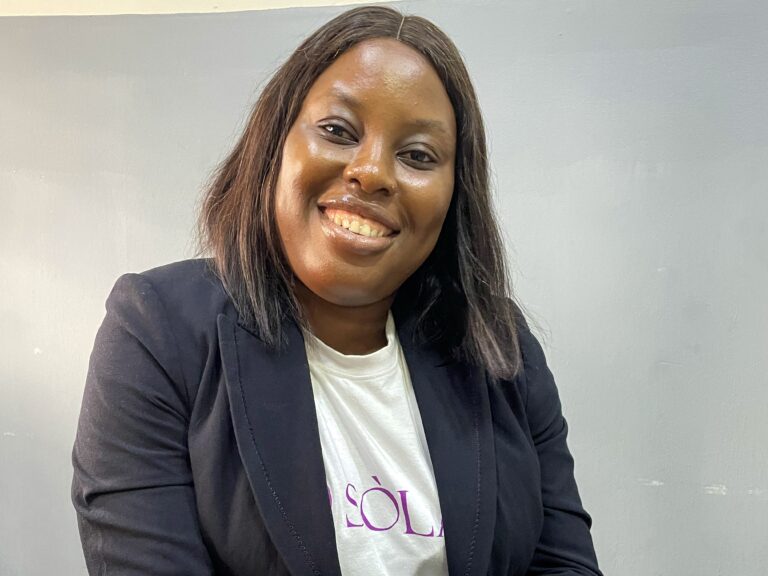
In a region known for having produced some of Africa’s most celebrated literary voices, Nigerian cultural entrepreneur Adachukwu Onwudiwe is building new spaces for stories to thrive. From founding a literary festival to launching publishing and media platforms, her work reflects a growing movement across Africa – one that offers creating new pathways for storytelling, readership, and cultural preservation.
Adachukwu Onwudiwe, bird story agency
The afternoon light settles over the distant hills with an unhurried grace, offering Adachukwu Onwudiwe a relaxing view from her home in Enugu, southeastern Nigeria. Growing up with a deep love for books and quiet reflection, Onwudiwe describes herself as a profound introvert; someone who needs silence the way others need food.
Yet, for a woman who prefers the quiet, she has made a remarkable amount of noise.
Over the past decade, Onwudiwe has built a literary festival, a digital publishing platform, a media studio, and most recently, a data intelligence operation — all driven by a determination to strengthen literary and cultural infrastructure in southeastern Nigeria.
Onwudiwe’s path to librarianship was accidental. Growing up, she planned to study law. However, when her 2005 application to the University of Nigeria, Nsukka (UNN) was stalled by a secondary school mathematics grade that fell short of the law department’s requirements, she had to pivot.
She reluctantly chose Library and Information Science, encouraged by an aunt who was thriving in the field. It was a choice she never regretted, ultimately launching her career as a research librarian.
“It doesn’t come naturally,” she says of the public convening and leadership her work demands. “But I decided a long time ago that what I needed to do was bigger than what I was comfortable with. So I found a way to become what the work needed.”
Her cultural entrepreneurship journey began in 2017 while she was working as a librarian in Enugu. After her request for time off to attend the Ake Arts and Book Festival in Abeokuta was denied, she decided to create a literary festival in her own city.
At the time, southeastern Nigeria — home to literary figures such as Chinua Achebe, Christopher Okigbo, Flora Nwapa, and Chimamanda Ngozi Adichie — had seen much of its literary infrastructure decline. Bookshops had closed, funding had dwindled, and many major cultural events had shifted to Lagos and Abuja.
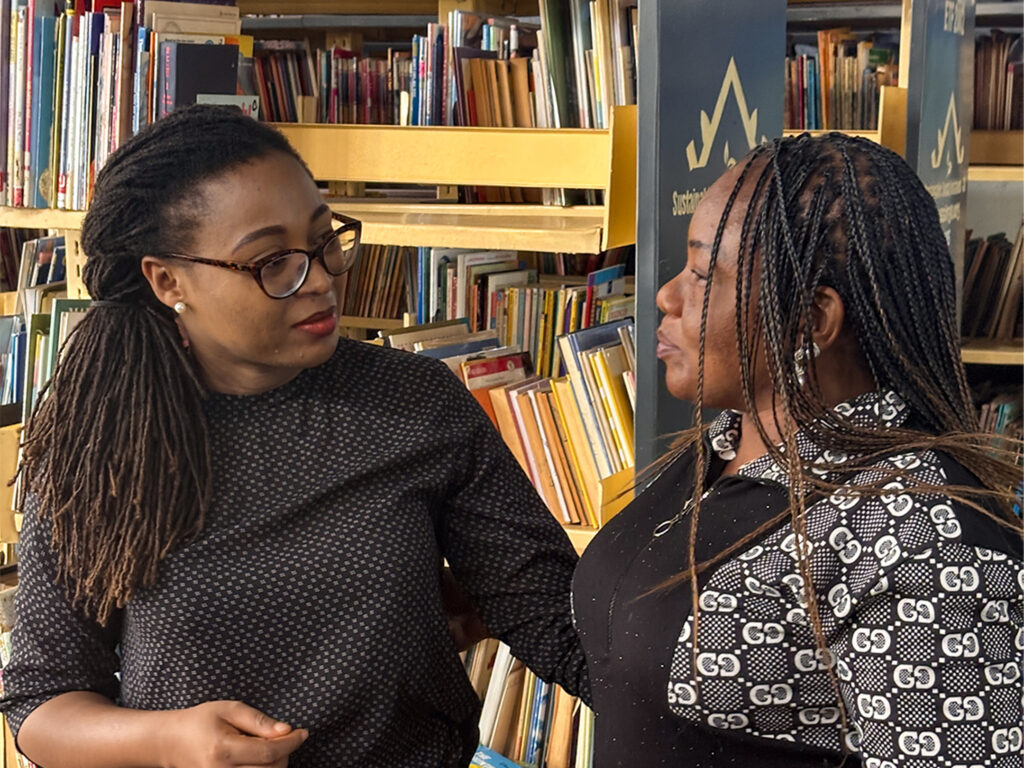
Adachukwu Onwudiwe at the Enugu State Central Library talking to one of the staffs about an upcoming program in Enugu, Nigeria on May, 2026: Photo: Toochi Gabriel, bird story agency
The decline reflects a wider continental challenge. According to a 2025 UNESCO report on Africa’s publishing ecosystem, the continent has only one bookshop for every 116,000 people and one public library for every 189,000 inhabitants, limiting access to books and literary spaces for millions across Africa.
Driven by a desire to create opportunities locally, Onwudiwe founded the Crater Literary Festival as a free platform accessible to emerging writers and readers.
“In 2017, as at the time I created Crater Literary Festival, there was no literary festival… you had to travel out of Enugu to attend a festival, and not everyone could afford to do that.”
The first editions operated on limited budgets, with plastic chairs and modest accommodations for visiting writers. Still, they attracted students, poets, and readers from neighbouring states including Anambra and Abia.
“A lot of people were in need of a space, in need of a platform where they could come and meet other writers, connect with them and also showcase their works,” she explains.
Mr. Godwin Chukwudubem, who owns one of Enugu’s few remaining independent bookshops, says the festival has helped revive interest in books.
“Recently, it seems there’s a decline in reading culture, but from what Adachukwu is doing, a lot of people are becoming aware that these books can still be found in the market,” Chukwudubem says. “That’s one of the best things she’s doing for us booksellers.”
Beyond the festival, Onwudiwe sought to tackle structural barriers facing writers in the region. In October 2017, she launched Crater Library and Publishers, focusing on digital publishing and e-books to reduce entry barriers for emerging authors.
“We have a lot of people doing independent publishing or digital publishing, and to do traditional publishing, you have to look outside of Enugu,” she notes. “Nigeria has so many writers — you are getting into a pool of competitors.”
Her commitment to quality quickly drew recognition from others in the publishing industry.
Dr. Chiadozie Okeke, lead executive at Just Prints publishing house, collaborated with Onwudiwe on an anthology project alongside the Enugu State Council for Arts & Culture.
“Her level of excellence and attention to detail is second to none,” Dr. Okeke says. “Her attention to details in ensuring that the work comes out like what we are doing here is second to none, and I will give it up to her when it comes to editing and ensuring that this work comes out perfect.”
Operating a digital-first platform in Nigeria, however, came with significant challenges. Maintaining digital infrastructure required constant investment, particularly for storing manuscripts, book covers, and multimedia content.
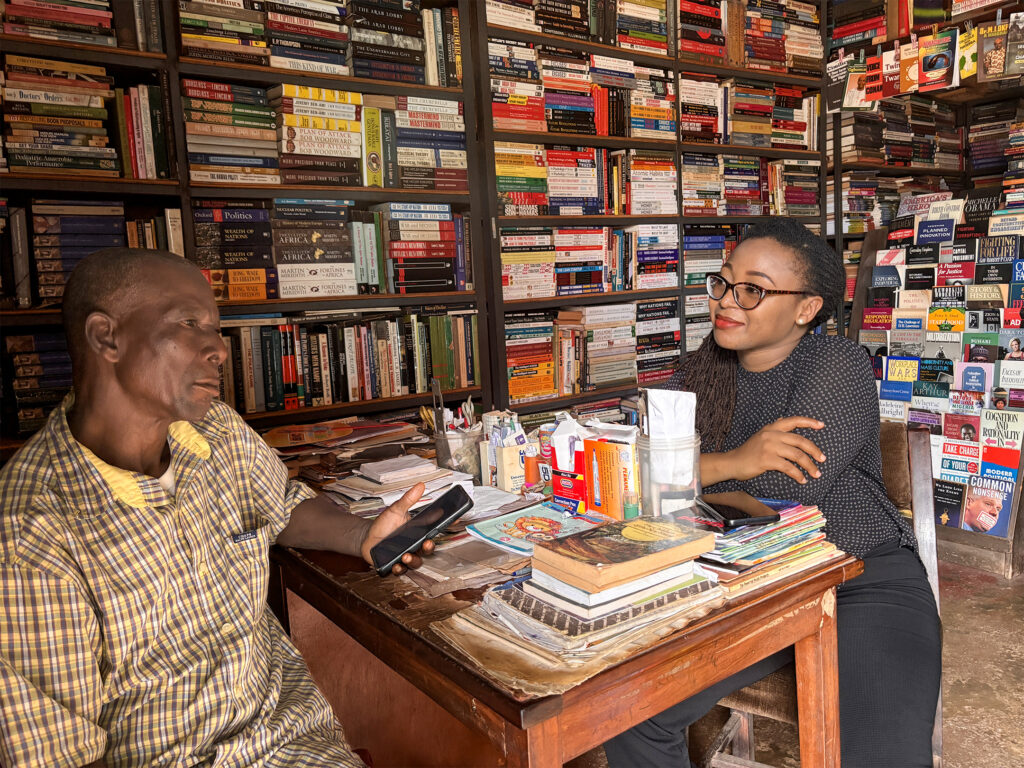
Adachukwu Onwudiwe with the Sir Godwin, owner of Willy M. Educational Books, one of Enugu’s State oldest bookshop , talking about the book business in Enugu, Nigeria on May, 2026: Photo: Toochi Gabriel, bird story agency
Digital publishing also faced cultural resistance, as many creators remained wary of putting their work online due to concerns about copyright infringement and weak intellectual property protections.
Despite these hurdles, the Crater Literary Festival expanded significantly. By its fifth edition in 2021, it had hosted more than a hundred writers and artists from countries including Ghana, Sierra Leone, and the United Kingdom, while also attracting support from institutions such as the British Council.
Once the platform was firmly established, Onwudiwe made the decision to hand over its operations to a Swiss NGO to support its expansion beyond Nigeria.
“Crater was my baby,” she says. “I think I got to the point where I felt it was time, and that made it easier… I saw the bigger picture. What I was doing set roots here, but I can have something that transcends the borders of Nigeria and Africa to other countries that need such platforms.”
The transition also pushed her toward another challenge: the absence of localized data in southeastern Nigeria. She observed that international funding systems and national statistics often overlooked the region because most data collection focused heavily on Lagos.
This realization led her into data science. She now serves as the Project Lead for Intelligence Production at Metrics & More Analytics, an Enugu-based firm that produces data across sectors including health, economics, and the creative industries.
For Onwudiwe, data analytics remains closely tied to storytelling.
“The work I do with Metrics & More Analytics is still dependent on the work I did with Crater and the work I do with Afrochives,” she explains.
Her latest venture is Afrochives Studio, a video content platform she co-founded to create cultural and literary programming tailored for online audiences.
“One of the reasons I co-founded Afrochives was because of what I learned… We talk about the reading culture, and yes we don’t have a lot of people reading, but we have a lot of people watching YouTube,” Onwudiwe says. “To me that is the quickest way to share information across Nigeria.”
Mr. Lawrence Ani, Executive Secretary of the Enugu State Council for Arts & Culture, says the region’s creative sector needs long-term structural support to grow sustainably.
“Well, I would say that it could be better, you know, it could be better. What I see is an industry, a sub-sector that is ready to go, but it needs some bit of a sustained support. It needs some sustained support and not just throwing money at a problem. We need some sort of structured support in a way that finds up-and-coming artists, creative persons, young persons, and then supports them in a way that really benefits them and enables their career to grow.”
UNESCO estimates that Africa’s publishing industry already generates approximately US$7 billion annually and could grow to US$18.5 billion with stronger investment in local publishing infrastructure, copyright systems, libraries, and reading culture.
Reflecting on her journey from librarian to cultural entrepreneur, Onwudiwe says her work has always been rooted in filling gaps where infrastructure is missing.
“Some purposes are like salt,” she reflects. “You won’t see them in newspaper headlines. But without them being added to the soup, the whole pot would taste wrong.”
When asked whether she imagined her work would help reshape the literary landscape of the region, she smiles.
“Honestly? I just wanted to go to a book festival.”
bird story agency