Many of the connections between Africa and Latin America—forged and lost centuries ago in the trans-Atlantic slave trade—remain largely unexplored. In southeastern Nigeria, a cultural initiative is reversing that, connecting Nigerians to “sisters” and “brothers” in the Spanish-speaking world through music, dance, and community.
Vera Chidimma, bird story agency
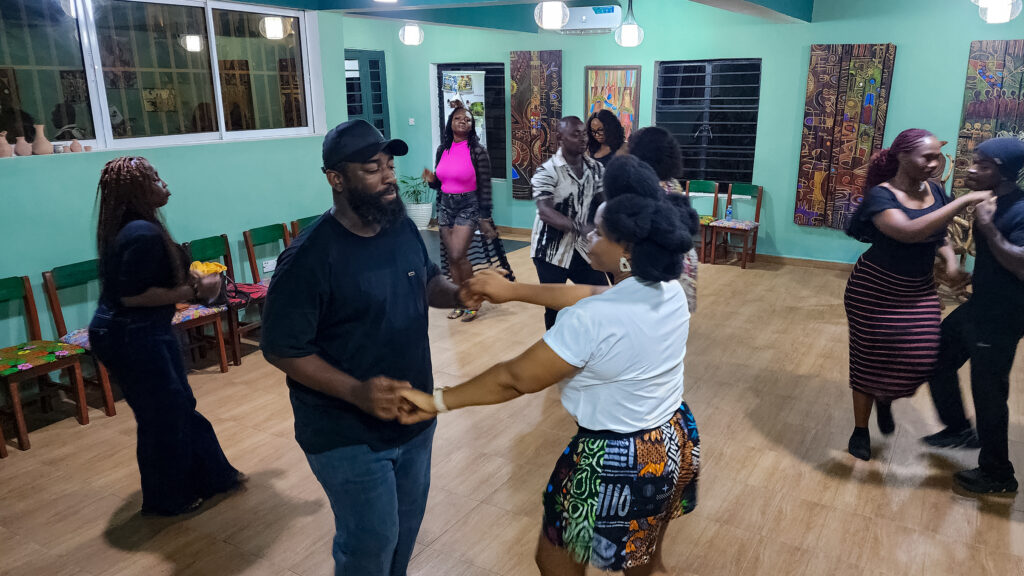
Music fills the room as pairs of students drift across the wooden dance floor, trying to keep in step with the rhythm. Some are confident, others hesitant as an instructor calls out the count in Spanish. Then, participants rotate partners.
This is a beginner’s salsa class, in Enugu, southeastern Nigeria. Yet it is also something else: a gathering place where language, music, and curiosity mingle as conversations switch between English and Spanish. For many in the room, this is also their first encounter with Hispanic culture.
“If we just said ‘come and learn Spanish,’ people may not come,” Uchenna Vasser, a professor of Spanish and the powerhouse behind today’s class. “But when they come for the experience, they begin to ask questions.”
The approach reflects the thinking behind SLANG Global, the cultural and language initiative founded that Vasser founded in 2022. Rather than beginning with grammar and textbooks, the centre introduces people to the Spanish-speaking world through culture. Salsa classes, karaoke nights, and shared meals serve as the entry point. From there, interest in language and history begins to grow.
For Vasser, the idea behind the project developed through a personal encounter that forced her to reconsider the relationship between Africa and Latin America. During a visit to North Carolina, USA, she recalls meeting a man who approached her warmly and called her “hermana”—Spanish for sister. The greeting caught her attention. It was not simply a polite gesture. It was recognition.
“He saw me and recognized himself,” she says. “And I realized that people like him don’t fully remember where they are from—but they know they are from Africa.”
The moment stayed with her long after the meeting ended. Across Latin America, millions of people trace their ancestry to Africans enslaved and forced onto ships during the trans-Atlantic slave trade. Many were transported from West Africa, including areas that are now part of Nigeria. Over centuries, their languages, beliefs, and cultural practices blended with others in the Americas, but elements of African heritage survived.
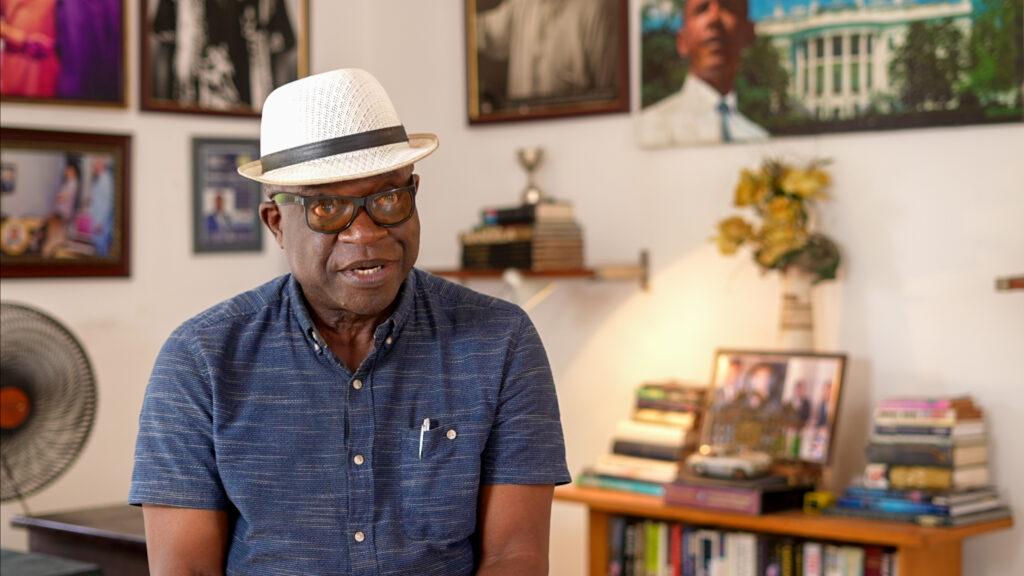
Ben Etiaba, a travel and cultural aficionado, during an interview with bird story agency at his centre in Enugu, Nigeria, on March, 24, 2026. Photo: Augustine Odenigbo, bird story agency
Vasser began to see the connection not only as history but as an unfinished conversation between two regions. If descendants of Africans in Latin America could still recognize traces of their roots, she wondered why those links remained largely unspoken in Nigeria.
That question became the foundation for SLANG Global. The project aims to reconnect people through language and shared culture while introducing Nigerians to opportunities that come with learning Spanish. Today, they have trained more than 60 women who can fluently communicate in Spanish. The “bridge,” as Vasser describes it, moves in both directions: learning about Hispanic cultures while also sharing African traditions.
The idea also reflects a broader historical reality. The trans-Atlantic slave trade, which lasted from the 16th to the 19th centuries, displaced millions of Africans across the Atlantic.
“If there was no trans-Atlantic slave trade, there would be no Spanish-speaking African diaspora, ”she said.
Enslaved people carried their languages, religious practices, and cultural systems with them. Over time those influences shaped music, cuisine, and social traditions in many parts of Latin America.
“You find it in the food, in the dance, in the speech,” Vasser said.
At SLANG Global, those connections are explored in everyday ways. Instead of presenting history as a distant subject, the center uses activities that allow participants to experience cultural overlap firsthand. Being an NGO, the students pay a small fee to learn the language which comes with music, art and community centered activities.
The building itself reinforces the atmosphere. The center operates from an older structure with a central courtyard, a design common in Mediterranean and Latin architectural traditions. It creates a shared space where classes and informal gatherings often blend together.
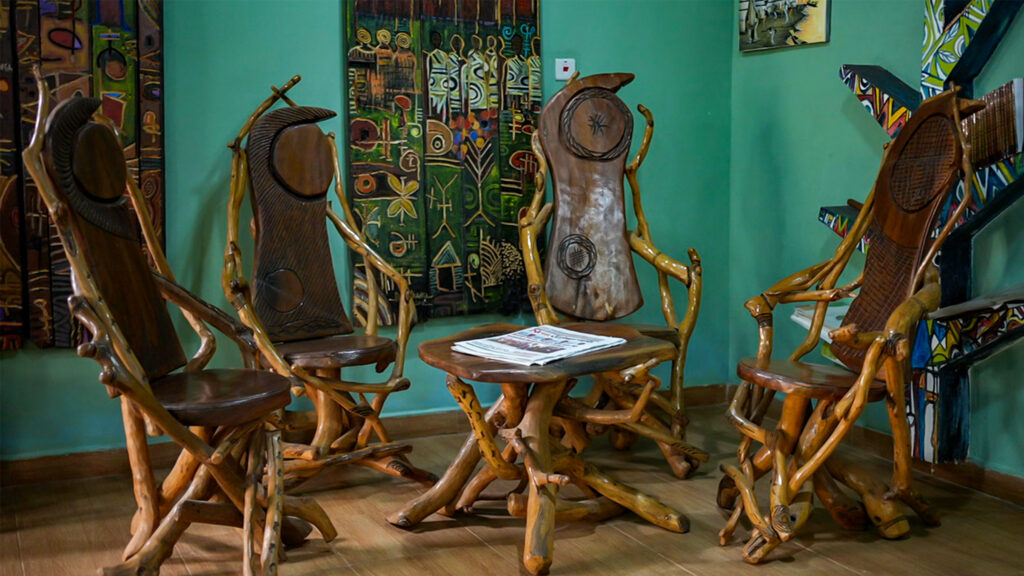
Handcrafted wooden chairs and a table sit in a room at Slang Global Centre in Enugu, Nigeria, March 20, 2026. Photo: Augustine Odenigbo, bird story agency
Inside one of the classrooms, a student named Mabel Mmesoma leans forward over her notebook, repeating Spanish phrases slowly. She pauses between words, searching for the correct pronunciation. Vasser listens, then gently corrects her, guiding the sounds until they come closer to the original. Mmesoma tries again, speaking a little louder this time. For Mmesoma, the experience has been a gradual shift in perspective.
“I didn’t really know much about them,” she says, referring to people in Latin America. “But now I see the similarities—in our food, our dance, even how we live.”
Learning Spanish has also changed how she sees her own possibilities. Speaking in class and practicing conversation has increased her confidence, she says. It has also made the idea of traveling feel more realistic. Countries like Mexico, Colombia, and Venezuela, once distant names, have become places she hopes to visit one day.
While students focus on language and cultural exchange, the initiative also includes a deeper conversation about history and identity. That perspective is often provided by Chief Ben Etiaba, a travel and cultural aficionado.
For him, the limited awareness of connections between Nigeria and Latin America is not surprising. Many Nigerians, he says, are focused on immediate concerns.
“We have bigger problems to worry about,” Etiaba said. “People are focused on survival, not on tracing connections across continents.”
Yet he believes recognizing those historical links could open new possibilities. Millions of Afro-descendants live across Latin America today, and many communities continue to preserve traditions that originated in Africa.
“There are our brothers and sisters out there,” he said. “If we recognize that, we can build relationships—cultural, economic, even tourism.”
Spanish is one of the most widely spoken languages in the world, with nearly 500-600 million speakers globally across more than 20 countries, including Equatorial Guinea in Africa.
“The future belongs to those who see possibilities early,” Etiaba said. “Those who understand this connection now will benefit from it.”
For Vasser, the goal is not simply to teach language but to expand awareness. She often measures the project’s success through small, unexpected moments. One of those happened when she was walking through town and a young boy greeted her with “Buenos días.” The greeting showed that something had begun to spread beyond the classroom.
“I knew he wasn’t my student,” she said. “But he understood what we were doing.”
Moments like that reinforce her long-term vision. Vasser hopes that initiatives like SLANG Global can eventually be integrated into Nigeria’s educational system, making cultural exchange and language learning more accessible. She also sees potential for programs to connect with national initiatives such as the National Youth Service Corps, allowing more young Nigerians to engage with global cultures.
At its core, the effort is about repositioning Africa within global cultural conversations. Rather than viewing connections with Latin America as distant history, Vasser believes they can have active relationships shaped by shared experiences, language, and collaboration.
Back in the salsa class, the music begins again. Students return to the floor, counting steps and adjusting their movements. Some are still learning the rhythm, but the atmosphere remains open and curious. Step by step, the bridge Vasser imagined is beginning to take shape.
bird story agency