By preparing and packaging sombé for busy households, a couple in eastern Democratic Republic of Congo is building a market for a familiar food, creating work and turning its production waste into fertiliser.
By Andrino Akuda, bird story agency
In Bukavu, sombé – pounded and simmered cassava leaves – is a staple. But preparing it takes time, and in a city built up the hillsides, many families who live on the upper floors of residential buildings do not have the space to pound it.
Built across steep hillsides, Bukavu’s mountainous terrain has shaped the way people build and live. In many parts of the city, homes are constructed vertically, with several floors accommodating different households or living spaces.
Living upstairs, says Julie Ishara, “you cannot pound sombé there”.
At 6 a.m., while Bukavu is just waking up, Héritier and his wife are already at Muhanzi and Elakat markets, meeting women farmers from surrounding villages to select the freshest, highest-quality cassava leaves, locally known as sombé.
They then head to Jolie Maison’s production facility, where their team is waiting with boiling water. The leaves are carefully sorted, while the spices are cleaned and selected before being mixed. The sombé is dipped in boiling water for two to five seconds, then ground together with the spices using a machine.
The final steps involve packaging, labelling and preparing the products for delivery. Before the day ends, the team records new orders and plans production for the following day.
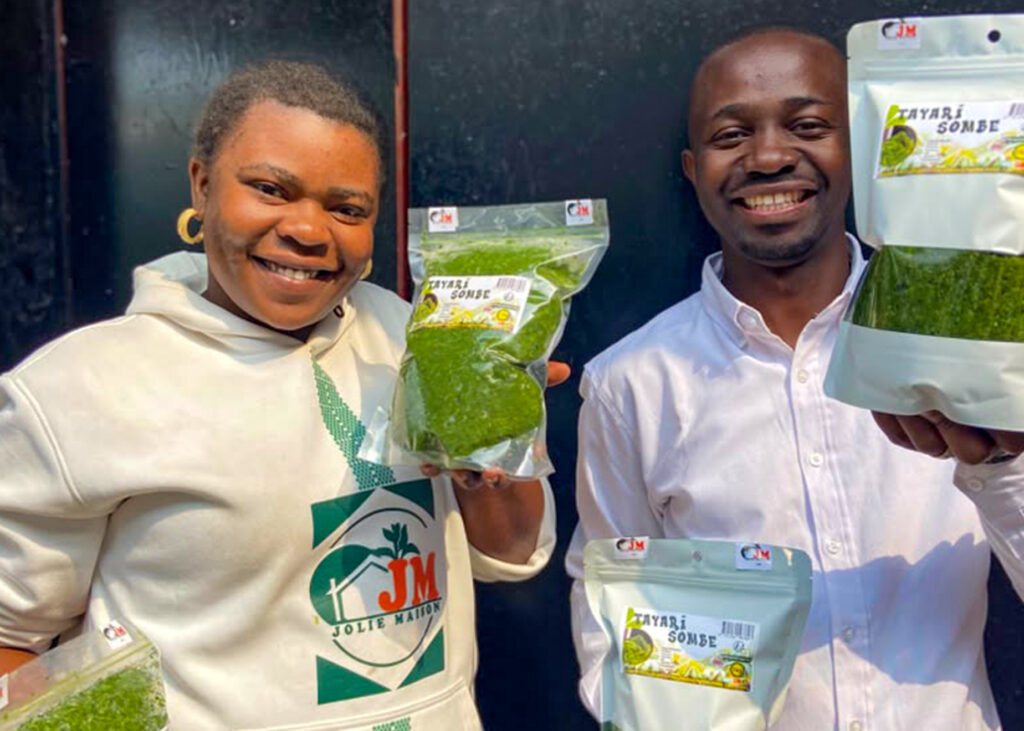
Three years ago, she and her husband Héritier Mastaki, an agricultural engineer, set out to solve the problem of solving sombé in multistory homes.
Their company, Établissement Jolie Maison, sells TAYARI SOMBE: pounded cassava leaves seasoned with leek, sweet pepper, celery and garlic, ready to go straight into the pot.
Their customers include students, working mothers, restaurants and caterers. Neighbours stop by the production site, a street vendor sells the sombé from a pousse-pousse, or handcart, and supermarkets stock it. Others phone in orders for delivery to their homes across Bukavu.
The phone rang even during the interview. Héritier took the call, then explained that the team had promised a customer a delivery at 11 o’clock and would have to leave soon. Orders taken the previous day were already arranged in delivery order, ready for him to bring round.
Among their customers is Wini Soko, who lives in the Ndendere neighbourhood of Ibanda commune.
“I buy it because it helps me cook quickly, it tastes good and it is well spiced,” she says. “Also, our upstairs homes do not let us pound. Tayari Sombe is served to us already pounded and spiced, which is why we are satisfied and ask them to carry on like this.”
With a baby to care for, she has little time to go to the market.
“It is brought to me directly and I cook.”
At the Luxuria Sky House supermarket, shop assistant Abigael Masika says the Tayari sombé sells well. “With just 4,000 francs (US$1.73) you get 1 kilo of sombé, of very good quality,” she says, adding that it comes with well-mixed spices. She adds that the spices are well mixed and that the product attracts at least 10 packs purchases a day, making it one of the supermarket’s most requested items.
Winning customers over took time. Ishara says many people believed machine-pounded sombé could not taste as good as traditionally prepared leaves.
“The biggest challenge at the beginning was making customers aware of our product,” she says.
The couple started by selling 10 kilograms a month. Today, they say they sell between 500 and 600 kilograms.
What began with the two of them is now a team of at least six, supplying three sales outlets in Bukavu. Héritier says the business supports around 15 people, not counting restaurant staff.
For Mugisho Buhendwa Théophil, the sombé has become a steady job. He spends his mornings preparing the product at the factory. Around 2 p.m., he sets off with a pousse-pousse, a handcart he pushes along a regular sales route through part of Bukavu. Starting at Axe 24, he passes through Feu Rouge and along Avenue Saïo and Avenue de la Bière before climbing towards Sonas. He stops at Baba Shingazi’s, then heads downhill towards the Feu Rouge market. By about 5 p.m., he says, he has sold at least 15 kilograms.
His customers are mostly mothers, including breastfeeding women and housewives with many children at home. “When they hear the pousse-pousse passing, it is a relief for them,” he says. The work pays him a monthly salary. “I am really happy to do this job with the pousse-pousse,” he says.
Orders are placed the day before, allowing the women who supply the cassava leaves to bring in the quantities needed overnight.
Preparing those leaves also produces waste. In what Héritier calls “a vertical city”, finding space to store it is difficult, and disposal can be costly for households. Jolie Maison itself generates more than a tonne a month.
Drawing on his agronomy training, Héritier set up composting units to turn the discarded material into organic fertiliser.
“We thought we could put that waste to use by producing fertiliser,” he says.
He sells it to households with container gardens or flowerpots, as projects across the city encourage residents to grow vegetables at home. Material left over from preparing one household’s meal can help another grow food.
Alongside the ready-to-cook cassava leaves, the company sells groundnut flour used to season sombé and other dishes. The couple also plans to offer palm oil and ready-to-cook hoof pieces which are in the launch phase.
Wini says she has already tried the kinono, or hoof pieces.
“They know how to choose good-quality kinono,” she says, adding that it cooks quickly.
The couple has supplied customers in Goma, across Lake Kivu, as well as Congolese people living in France and Norway. They are also developing a dehydrated sombé for customers farther away.
“Sombé was something people might have overlooked, but today it can appear on supermarket shelves,” Héritier says.
They want to build on that progress, selling internationally, employing more Congolese workers and encouraging young people to start businesses of their own.
“It is not easy, but it is worthwhile,” Héritier says.
For Héritier, the reward is seeing how their work changes a customer’s day. “When we deliver to a household and see a mother relieved because she has found a solution to her problem, for us, that is a great source of satisfaction,” he says.
bird story agency