For travellers exploring Uganda with Denis Ssebayiga, conversation is part of the journey. His Deaf-led tourism venture offers tours in sign language while working towards a bigger ambition: creating opportunities for Deaf people to earn a living as guides.
By Phoebe Masongole, bird story agency
For Alex, a traveller from Germany, the road from Kampala to Mbale offered something his previous bus journeys had not: hours of conversation.
Travelling with Denis Ssebayiga, a Deaf guide and co-founder of SS Sign Language Tourism, he could ask questions, exchange experiences and enjoy the company of someone who communicated in sign language.
“One of my most memorable moments was the long drive to Mbale. In the past, I usually traveled by bus, and those journeys could be quite boring. With Denis, however, I could chat in sign language for hours,” Alex, who wanted to use only his first name, says.
Alex, who knows Ugandan Sign Language, discovered the company through Instagram and booked a trip with his friend, Flo. Being able to communicate directly with their guide changed the experience for both of them.
“What was especially nice was seeing how well my friend could also communicate with Denis. This meant I hardly needed to interpret, which made the trip more relaxed for everyone,” he says.
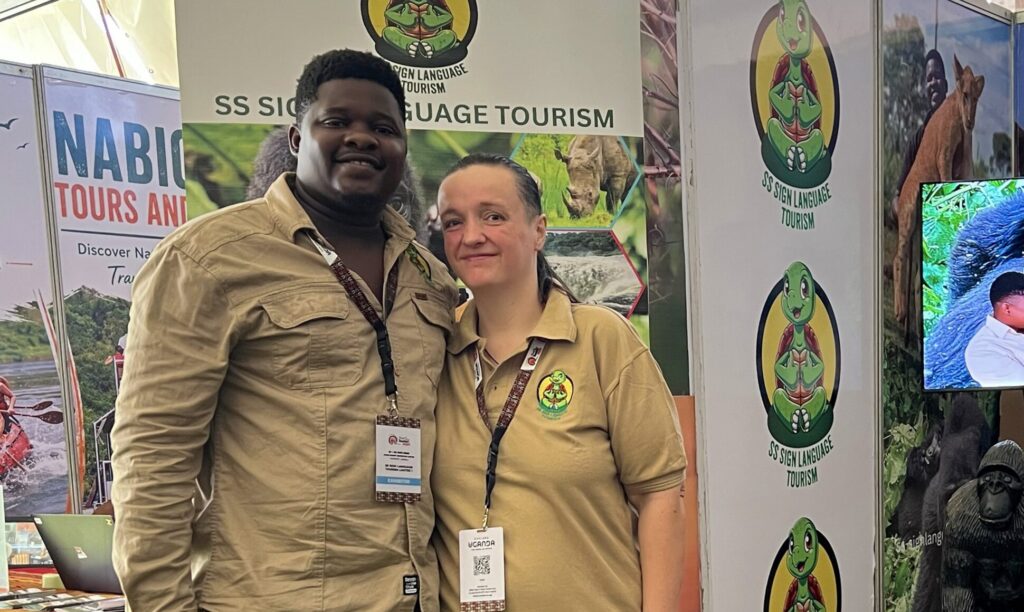
For Ssebayiga, these conversations are central to the business he established with Simone Pabsch in November 2024. The founders want Deaf travellers to explore Uganda with guides they can communicate with, while opening opportunities for Deaf people to work in tourism.
Their venture is still small, and bookings do not yet cover its operating costs. But its early tours show what direct communication can bring to a journey, from understanding wildlife to sharing a joke during a long drive.
The venture is taking shape as Uganda’s tourism industry expands.
International tourist arrivals reached 1.64 million in 2025, up 19.7% from the previous year, while tourism receipts rose 21.3% to Shs5.83 trillion (US$1.62 billion), according to the Ministry of Tourism, Wildlife and Antiquities.
Discovering Uganda at her own pace
For Annika, a traveller from Spain, the company’s flexibility was as valuable as its approach to communication.
The team collected her from her hotel, listened to her interests and helped her decide what she could realistically see in the time available.
“I didn’t have to organise much myself. They picked me up from my hotel, and we planned the trip around what I wanted to see and do. They made recommendations and helped me work out what was realistic for the time I had,” she says.
Annika says her sister helped interpret when she did not understand Ugandan Sign Language. She also learned some Ugandan signs along the way.
“I’m used to working with people from different language backgrounds, so adapting to different ways of communicating felt quite natural,” she says.
“Communication was easy, and it was lovely to learn some signs as we went.”
A visit to a coffee farm at an inclusive school stood out. There, she learned about the stages of coffee production and watched how the beans develop.
She explored Kampala, stopping at a market to buy earrings. Beyond the city, the countryside and unexpected sights became some of her most vivid memories.
“But I also loved just discovering Uganda. The drive from Rwanda, the countryside, the nature, and all the unexpected things you see along the way. Pigs and chickens on motorcycles, for example! Those are the kinds of things you remember,” she says.
A safari had been on her list, but the team advised postponing it because the time available would have meant too much driving.
“I appreciated that they helped me make the most of the trip rather than trying to squeeze everything in,” she says.
Even an hours-long traffic jam became a chance to appreciate her guide’s company.
“And Denis deserves a special mention. He’s hilarious and great company,” Annika says. “We got stuck in an absolutely crazy traffic jam for hours — I’d never seen anything like it — and while everyone else was getting frustrated, Denis stayed cheerful. He made even the long, challenging parts of the journey fun.”
Guiding through sign language
Ssebayiga says the company uses Ugandan Sign Language when guiding Deaf visitors from Uganda and International Sign when communicating with international Deaf travellers, depending on their needs.
Facial expressions, gestures and visual demonstrations also help guides and visitors exchange information.
His approach draws attention to what travellers can observe: how animals move, feed and interact, how birds fly, and how the surroundings change with wind and rain. Sign language helps him explain those observations and discuss conservation.
“I can explain what we observe in sign language, allowing Deaf travelers to learn, ask questions and enjoy the experience without depending entirely on hearing people to interpret information for them,” Ssebayiga says.
For him, guiding brings together a love of Uganda and an interest in meeting people.
“I have always wanted to work in tourism because I love meeting people, exchanging ideas and sharing experiences with others,” he says.
“I want to show people living with disabilities like the deaf how beautiful and special Uganda is. Our country has amazing wildlife, beautiful landscapes, rich culture and many wonderful places to explore.”
The reward comes when visitors can follow an explanation, ask their own questions and engage with what they are seeing.
“Seeing their happiness because of understanding brings me joy and motivates me to continue working in tourism,” he says.
Building a business
Pabsch says she and Ssebayiga recognised that their different skills could help them build the venture together. They invested their own money in a van to get it started, despite uncertainty about whether the business would become financially sustainable.
“What motivates me most is creating better access to tourism, education and knowledge for Deaf children, young people and adults,” she says.
“We want Deaf people to learn more about their own country, its wildlife, nature, culture and the importance of protecting the environment.”
The company has completed approximately 10 tours and served more than 30 Deaf travellers, according to Pabsch. She describes the figures as estimates because its record-keeping is still improving.
Those early bookings have given the founders experience, but they have yet to generate enough income to cover all operating costs. Fuel, transport, accommodation and park entrance fees place pressure on the business.
Professional training and a reliable safari vehicle are among their priorities.
“Denis is eager to complete professional tour guide training, but we currently lack the financial resources to cover the costs,” Pabsch says. “We also hope to invest in a suitable safari vehicle so that we can organize tours more reliably.”
The founders say recognition by Condé Nast Traveler has drawn interest from potential partners. Turning that attention into practical support and lasting partnerships remains a task ahead.
For the company to grow, it needs regular bookings as well as resources to improve transport and develop guiding skills. Its ambition to bring more Deaf people into the business depends on creating enough paid work to sustain those opportunities.
“Building a bridge between Deaf and hearing people is very important to me,” Pabsch says. “Through tourism, we want people to learn from each other, communicate together and share meaningful experiences.”
Opening routes into tourism
The barriers the founders face extend beyond finding customers. Access to professional training and the money to pay for it will help determine whether their venture can become a source of employment for other Deaf guides.
Globally, the World Federation of the Deaf estimates that more than 70 million people belong to signing Deaf communities. That points to a substantial potential audience for tourism delivered in sign language, although the estimate does not measure how many people travel or can afford to do so.
For businesses such as Ssebayiga’s, the opportunity lies in turning accessible communication into experiences visitors will book.
Their experience also points to a wider question for tourism operators and training institutions: how to make communication accessible for visitors while opening routes into the industry for Deaf professionals.
Robert Nkwangu, executive director of the Uganda National Association of the Deaf, has called for stronger legal protection and promotion of Ugandan Sign Language to improve access to services and opportunities.
“We appreciate the government’s efforts to mainstream disability inclusion and recognize the importance of sign language in promoting the rights of deaf and hard-of-hearing individuals,” he said.
He called for a comprehensive Ugandan Sign Language law to strengthen accessibility and equal opportunities for Deaf people.
For travellers, accessible communication can mean being able to ask a guide about an animal, understand the story behind a place or change an itinerary. For prospective guides, access to training can help turn knowledge and enthusiasm into a profession.
SS Sign Language Tourism is attempting to bring those needs together, although its founders are still building the financial base to do so consistently.
Annika’s advice to future customers is to begin with their interests.
“If you’re thinking about traveling with them, tell them what you’re interested in and what you’d like to experience. You don’t have to arrive with a complete itinerary. They’ll help you work it out,” she says.
For Alex, the value was already clear on the road to Mbale. Ssebayiga hopes to earn a living making that connection possible for more travellers.
bird story agency