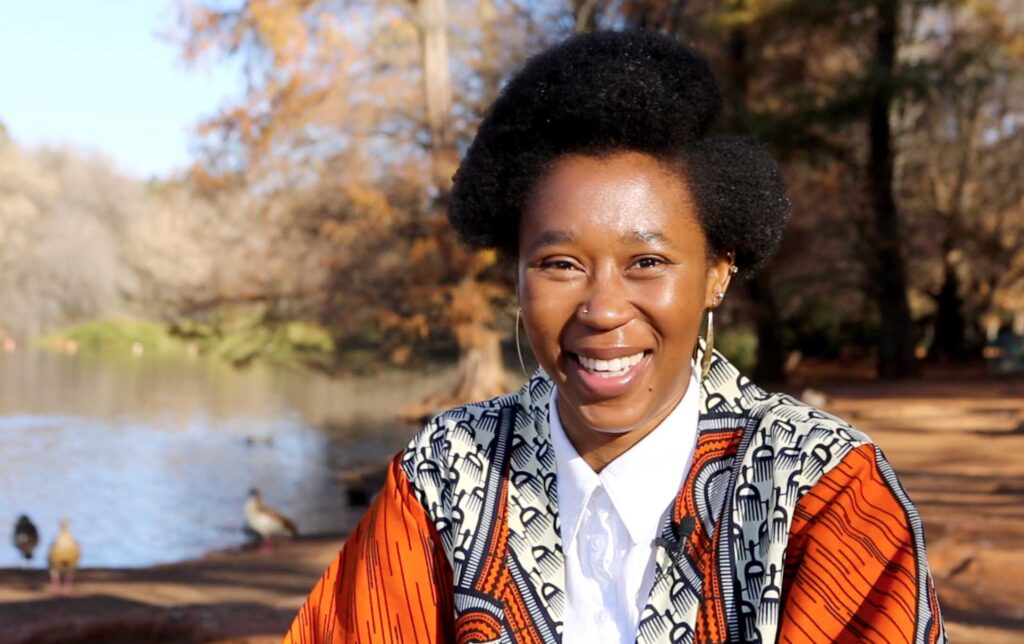
Fashion designer Gugulethu Quwe had questions about cultural pride and identity when she spent time teaching overseas. Years later, she answered those questions – with a children’s line designed to build African pride.
By Ntshepeng Motema
In 2011, two years after graduating with a degree in fashion from Tshwane University of Technology, Gugulethu Quwe was struggling to find a space for herself in South Africa’s fashion industry, so she took time out. Then came a move to South Korea, to teach English. Thrown into a completely different culture, she found inspiration unexpectedly.
“Just seeing the pride my students had, in what belonged to them, everything they could say, “teacher, this is made in Korea”. It made me wonder, what would it feel like as an African child to even have that expressed in how you dress, to grow up with that sense of ‘Made in South Africa’ or, ‘Made in Kenya’ or, ‘Made Anywhere on the Continent’, but you knew this was from your people and specifically for you.”
Quwe had never considered making clothes for children but her experience in South Korea planted a seed. On returning to South Africa she wondered what would generate that same sense of national, or cultural pride, in other Africans. She looked at African print and how it was used – but things didn’t add up.
“People associate African print with weddings or big occasions which doesn’t make sense because what that message translates to the kids is that our attire is almost like a costume, so then children don’t get to see it as an everyday part of themselves….why do we have this thing as Africans that our clothes are something we put on and not who we are?”
For years, questions like this lingered in Quwe’s mind. It wasn’t until 2013, when she became a mother, that the answer became clear to her: she had to start a children’s clothing brand. It would need a strongly African design base.
Quwe was looking at Ankara, or African wax print, also known as Kitenge. This fabric, she felt, would have the power to influence how children felt about themselves. If children saw themselves reflected in the clothes they put on, she believed, that would instil a sense of cultural pride. They would grow up to be more aware of who they were and have a stronger connection to their African roots.
Ankara prints, she believed, would allow her to make clothes that would make a child feel whole, with a beautiful culture and heritage to match.
“Once children already understand who they are, it’s one thing just not to worry about. Then you are just able to present yourself to the world authentically and carefree. That means you are always able to present your best self.”
To set up Happi Llama, a brand whose name embodies the spirit of children’s innate happiness, this budding designer first had to look around to see what was on the market. To her surprise, her fact-finding mission was a short one. She quickly discovered that Ankara prints were largely ignored by mainstream fashion. The companies making children’s clothes, she realised, were looking in a very different direction when it came to the look and feel of the garments.
Quwe knew she had an opportunity. She wanted her designs to be contemporary. “I’d seen children wearing patterns that were either badly made or an adult version of a garment and so our goal was to produce high-quality children’s clothing that any kid would be proud to wear.”
She began to experiment and innovate. The result was the funky jumpsuits, daring dresses, statement baby bibs, colourful diaper covers and dungarees designed perfectly for playing in, that her brand is now associated with. As her son Khwezi grew, he, too, became a source of inspiration and collaboration for her designs.
Walking on the crowded sidewalks of downtown Johannesburg on a recent sourcing trip to the area, the bold colors of Quwe’s floral African print Kimono catch the eyes of admiring passers-by. A regular in this part of town where Ankara cloth is sold by a number of West African vendors, she’s fondly known as Llama Mama. Hurrying through the crowd, Quwe’s Afro glistens in the sunlight.
Inside her favourite Ankara shop, Quwe takes her time to find the best prints of the day. “I look at the prints and specifically from what I am seeing or finding, then I am able to go back home and design.”
She spends hours looking at and feeling the material and allows the fabric to not only capture her heart but ultimately guide her in her creative process.
“I don’t specifically design something and come here to find fabric. I am always slowly taking my time looking at the prints. And they scream at me and say, ‘make pants, make a jacket, make a skirt’.”
While it’s the distinct colours and elaborate patterns that attract Quwe to Ankara, it’s the powerful meanings that these fabrics hold that seals her love for them. As they come on the market, Ankara patterns follow social and political events. That makes them a chronicle of contemporary history in Africa.
“I love that the prints allow you to interpret them and make them meaningful to you,” she says, adding, “It’s nice to go on these shopping sprees, to take the clients along, as much as I see something, somebody else is seeing something for themselves.”
While wax print originated in colonial-period Indonesia, it’s this naming tradition that Quwe feels makes Ankara uniquely African. She shrugs off the idea that her cultural pride might be misplaced. Wax print designs were first traded in West African coastal towns in the mid-1800s. A Dutch trading company, now named Vlisco, made huge profits when it mechanized an intricate method taken from the Indonesian island of Java and which had been practised by hand for centuries. Once the print got to West Africa it was embraced and made iconic – every reason, according to Quwe, why Africans have the right to lay claim to it. The fabric is iconic not only in West Africa; in East Africa, where it is known as kitenge, it is part of regional culture from Somalia in the north to Mozambique in the south.
“Every time you present the fabric to any person, their immediate response is that it’s African print, because there is a way that we have taken the fabric and made it our own. We own it so beautifully,” she said.
“Which culture has allowed Ankara to be seen in the way it is currently?”
“It’s Africans. So if you say it’s not ours, it defeats the purpose. Yes, products travel globally, there’s different products, they might not necessarily be made by those people. But the person who takes the product and elevates it, usually you would say, they are allowed to own some part of that story.”
Quwe is big on collaborating with entrepreneurs from other African countries. “By interacting with different people in South Africa I am getting to experience different countries without necessarily even leaving my own, I love that part of the business,” she said.
In the fabric shop, she takes time to connect with the Nigerian woman store owner. She is constantly developing as a professional through the people she interacts with, she says.
“The best tailors are Ghanaian and Malawian, and so it’s nice to just see how we exchange skills and expertise and the feedback on business acumen that the different countries have.”
It is in her studio that Happi Llama garments are brought to life. Quwe laughs easily with her multicultural team. Lead tailor Fauwaz Abdul Rahim sports an endearing smile and the tribal markings of his clan on his cheeks. He came to South Africa from Ghana in 2003 and has developed his craft since then. He shares a natural warmth with Quwe and their mutual respect is clear. This is where the magic happens. Quwe has clearly chosen her business partner well: Abdul Rahim and his team obsess over quality. To them, they aren’t just sewing clothes. With each garment, they get to stitch a different narrative about Africa.
“Most people think that anything that comes from Africa doesn’t have a good quality,” Abdul Rahim says. “So that is what in essence we are trying to break. When it comes to fabric and workmanship we don’t compromise. We want people to know that in Africa we can make anything, especially clothing that can compete globally.”
It seems this outlook is resonating with Quwe’s clients. Through her Instagram page, @HappiLlama_Kids, she has attracted buyers from around the African continent as well as the diaspora, including from Germany, Finland and the United States.
Elsewhere in the studio, young clients are finding outfits. Five-year-old Imara and seven-year-old Nalo twirl in front of the mirror. “I feel beautiful,” says Nalo, fluffing the fabric of her skirt as she gazes at herself in the mirror, adorned in one of Quwe’s designs. The pattern is a beautiful burst of colour. Big flowers in different shades of green catch your eye, perfectly blended with the soft pink and sprays of purple coming out through the background. Claudia Sefatsa has brought her daughters in for a fitting of their matching outfits. Her family have been customers since Happi Llama was launched.
While the mother of two is a natural fashionista who loves Quwe’s fresh designs, Sefatsa feels she is also nurturing her daughters’ sense of self-love by dressing them in their heritage. “I grew up around African print, so for me it’s passing on that knowledge to Nalo and Imara so that they know where I come from, especially being Mozambican, and just for them to also have diversity and a variety.”
Imara and Nalo emerge from the fitting room glowing with excitement in their free-flowing identical skirts. The girls love the fabric and are delighted by the frilly hem, a classic touch of Happi Llama flair. Their faces light up with big smiles as they admire themselves, twirling around and quickly breaking into a dance. Quwe looks on with satisfaction. For her, nothing could be more precious. As a designer she is not just making customers happy, she’s also planting the seeds of a new way for children to see themselves.
bird story agency
This story was first published by bird story agency on August 10, 2021: https://bird.africanofilter.org/stories/the-ankara-inspired-kids-designer-building-african-pride?locale=en